The Power Convergence: Wall Street Giants and APAC’s Tech Elite Bet Big on Institutional AI
Nasdaq Ventures’ investment in Transient.AI brings Wall Street backing to its effort to move agentic AI from institutional experiments into regulated financial workflows. In Asia Pacific, the company is pairing its bank-grade technology with a leadership team drawn from UBS, GIC and other established institutions.
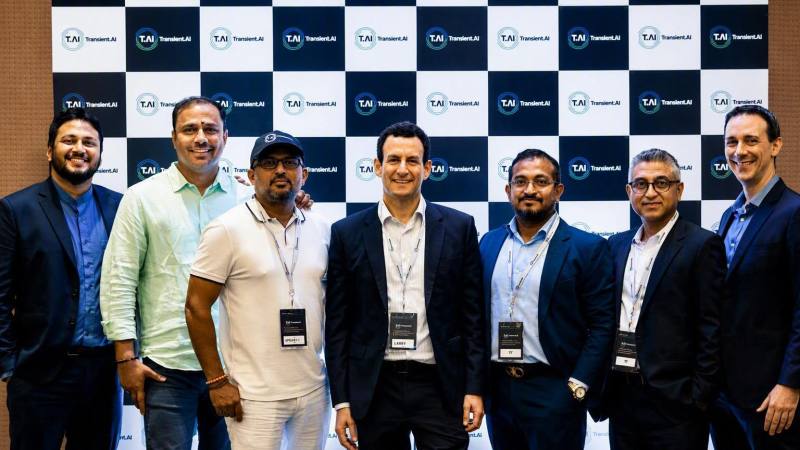
From Left: Sanju Menon, Ashok Balasubramanium, Sreej Menon, Larry Beck, Sreekesh Menon, Sonny Panesar and Courtlin Holt
Opinions expressed by Entrepreneur contributors are their own.
You're reading Entrepreneur Asia Pacific, an international franchise of Entrepreneur Media.
In an era where financial institutions are desperate to transition from experimental AI copilots to live, autonomous workflows, a major structural wall remains: security, compliance and zero-trust perimeter requirements. Enter Transient.AI (Transient), the fast-growing AI operating system purpose-built for regulated markets.
To validate its mission to deliver enterprise-grade, policy-driven AI across global institutions, Nasdaq Ventures recently announced a strategic investment in Transient, joining lead investor NEXT Investors in its Series A financing round.
“Nasdaq’s investment validates that regulated markets require a bank-grade approach to AI,” says Sreej Menon, CEO of Transient. “We built the platform to serve as the intelligence layer for global markets—unifying fragmented data and legacy systems into a governed execution environment. Having Nasdaq as a strategic investor and client is a force multiplier as we scale.”
“Transient stands out for its ability to embed governance controls with AI deployment at scale,” adds Gary Offner, senior vice-president and head of Nasdaq Ventures. “That transformative capability, combined with the team’s deep expertise in regulated markets, is why we are investing in their growth.”
At the core of the company is its technology foundation, engineered by co-founders Sreej Menon and his brother Sreekesh. Leveraging childhood chemistry and Wall Street technology credentials, the brothers built Transient’s Declarative Agentic Framework (DAF) and purpose-built agent swarms, Caddie.AI, to deploy directly inside a bank’s or fund’s secure cloud perimeter.
However, building breakthrough technology backed by Wall Street powerhouses is only half the battle. To scale across Asia Pacific’s complex financial centres, Transient pulled off something even more compelling: convincing an elite cohort of established corporate titans across APAC to walk away from high-prestige careers and bet on the rising start-up.
The Catalyst in APAC: Sonny Panesar’s Leap from Banking Stability
At the centre of Transient’s regional expansion is Sonny Panesar, CEO of Asia Pacific. Before taking the helm, Panesar was product owner for AI in UBS’s wealth management lending department, driving GenAI adoption across global engineering teams while navigating strict banking compliance.
When corporate budget cuts threatened to stall enterprise AI adoption, Panesar made his move. “I wanted to be on the true frontier of AI and move at a speed corporate environments couldn’t match,” he says. “When Sreej approached me to join, I didn’t hesitate.”
Giving up enterprise stability brought personal hurdles. “My wife, who runs her own business, was initially strongly against it,” Panesar admits. “She saw no reason for me to exchange corporate stability for start-up stress. But once I explained that I needed to test myself on a new frontier, she gave me her full backing.”
Out in the market, sales meetings confirmed his decision. “Every enterprise is desperate for real AI expertise. Most organisations are stuck at the basic chatbot phase, running into walls around safety, reliability and traceability.” Today, Panesar is implementing enterprise “digital twins” directly on bank floors to transform how institutions capture and act on collective intelligence.
The Institutional Titan: Larry Beck’s Bet on Direct Impact
Panesar’s move set off a domino effect. To drive regional strategy and commercial execution, Transient brought on Larry Beck as president, Asia Pacific. A 30-year institutional finance veteran, Beck previously led technology at Singapore’s sovereign wealth fund, GIC, following senior leadership roles at Credit Suisse and Morgan Stanley.
“Before Transient, I spent most of my career inside large financial institutions,” says Beck. “What caught my attention was the focus on getting AI into real financial-services work while running within a client’s own environment, keeping control of its data and providing a full audit trail.”
Recruited into early conversations by Panesar and having known Sreej from Credit Suisse, Beck spent months as an adviser before stepping into the executive suite full-time.
“Former colleagues were encouraging,” Beck notes. “Their view was that, at this point in my career, I should do something I’d really enjoy. ‘Fun’ is a respectable consideration when deciding how to spend your day. I wanted to get properly involved with a direct impact on the company’s success.”
The R&D Architect: Sanju Menon on Escaping Corporate Safe Bets
Adding to the wave of tier-one talent, Sanju Menon joined as APAC CTO and head of Transient Labs after spending years leading R&D, venture building and AI initiatives inside a major Swiss bank. With more than 12 years of AI leadership across banking, automotive finance and marketing, Sanju saw firsthand how corporate inertia held back transformation.
“Large enterprises were often simply too big to fully capitalise on the opportunity,” he explains. “Outside of a small group of forward-thinking people, large banks naturally gravitate towards safe, incremental bets, but those bets frequently undersell AI’s transformative potential.”
Sanju’s connection to Transient came through Panesar, who was briefly his manager at the bank while setting up a pod focussed on agentic reliability. “We recognised a shared challenge, and when the opportunity arose to join Transient, it felt like a natural continuation of the work we had started,” says Sanju. “Industry peers feel I’ve come into my element here—pursuing a much broader range of opportunities without being constrained by a single vertical.”
Now leading technology strategy and heading Transient Labs, Sanju focusses on advancing “human-in-the-loop” AI. “We are building agents that operate with greater autonomy without depending on granular human review at every step,” he adds. “Instead of burying business logic inside prompts or code, our declarative approach makes intent, constraints, permissions and escalation points explicit.”
The AI Scholar & Engineer: Courtlin Holt on Escaping PE Gridlock
Courtlin Holt, chief AI officer for Asia Pacific, oversees regional engineering and contributes code directly to core products. Holt’s path to Transient was forged out of frustration with corporate innovation limits while serving as global head of AI and data in the testing, inspection and certification sector.
“They had a mandate to cut costs following a private equity funding round, so they sharply reduced the AI innovation budget for the next 12+ months,” recalls Holt. “AI does not stand still—that was not acceptable.”
When Panesar, a classmate of Holt’s in a doctoral programme focussed on AI, told him he was joining Transient, Holt followed.
“If Transient was good enough for Sonny, who could walk into any major bank in Singapore and get hired on the spot, it was good enough for me,” says Holt. “My wife’s only condition was that I wasn’t allowed to work for any more start-ups that only paid in equity!”
Demonstrating Transient’s platform to potential clients quickly validated his choice. “It is not uncommon for prospective clients to say that Transient’s products are 12 to 18 months ahead of what their internal teams have been struggling to build.”
The APAC Reality: Production over Proofs-of-Concept
Anchored in Singapore, Transient is aggressively expanding across Asia Pacific, a market requiring extreme adaptability across diverse regulatory frameworks, data residency rules and operating cultures.
“Across APAC, there is no single default for language, cloud infrastructure, model provider or regulation,” notes Sanju. “India brings enormous engineering depth, while Singapore provides access to institutions with demanding security requirements. Those strengths are complementary.”
“Enterprise AI in APAC cannot be one-size-fits-all,” emphasises Beck. “It has to be portable, but locally governable. Enterprise AI will be judged in production, not in demonstrations.”
From the foundational engineering of the Menon brothers to strategic backing from Nasdaq Ventures and an all-star team walking away from GIC, UBS and tier-one banking incubators, Transient is proving that the real competitive advantage in enterprise AI isn’t just algorithms. It’s having the market credibility and institutional trust to bring tech into live production.
In an era where financial institutions are desperate to transition from experimental AI copilots to live, autonomous workflows, a major structural wall remains: security, compliance and zero-trust perimeter requirements. Enter Transient.AI (Transient), the fast-growing AI operating system purpose-built for regulated markets.
To validate its mission to deliver enterprise-grade, policy-driven AI across global institutions, Nasdaq Ventures recently announced a strategic investment in Transient, joining lead investor NEXT Investors in its Series A financing round.
“Nasdaq’s investment validates that regulated markets require a bank-grade approach to AI,” says Sreej Menon, CEO of Transient. “We built the platform to serve as the intelligence layer for global markets—unifying fragmented data and legacy systems into a governed execution environment. Having Nasdaq as a strategic investor and client is a force multiplier as we scale.”