2025 Beverage Market Data: Where Growth Is Moving – and Why RTD Coffee Stands Out
One of the beverage market’s biggest growth opportunities is still surprisingly underdeveloped.
.
Opinions expressed by Entrepreneur contributors are their own.
You're reading Entrepreneur Asia Pacific, an international franchise of Entrepreneur Media.
Mordor Intelligence values the global RTD coffee market at $26.19 billion in 2026, yet in many markets the category remains far less developed than established beverage segments.
While beer, wine, spirits, juice, drinking milk and carbonated soft drinks are declining or struggling to grow, RTD coffee is one of the relatively few categories still expanding strongly. For distributors, shelf-stable products add another advantage: they can move through existing beverage networks without the cost and complexity of a cold chain.
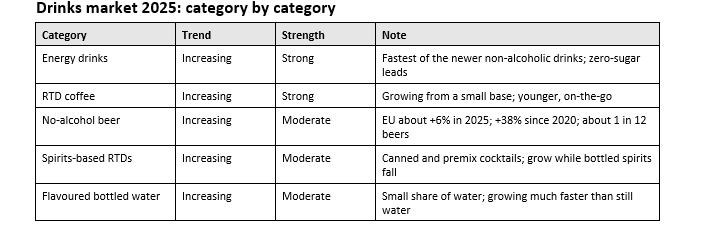
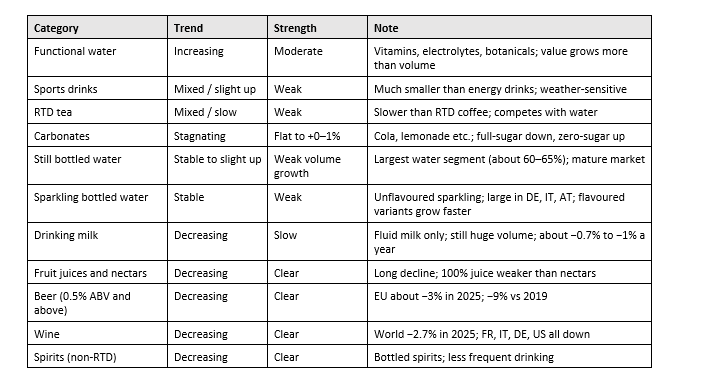
Compiled from official and industry statistics, mainly Eurostat, USDA FAS, The Brewers of Europe, OIV, IWSR, Statista, Euromonitor and Mordor Intelligence (2024–2026).
The losers
Beer consumption in the European Union fell 3.2 percent in 2025 and is down 9.2 percent since 2019, according to the European Beer Trends report published by The Brewers of Europe in July 2026. Global beer production fell about 1 percent in the same year, according to the BarthHaas hop report.
Wine is worse. World wine consumption fell 2.7 percent in 2025 to 208 million hectolitres, the lowest level since 1957, according to the International Organisation of Vine and Wine (OIV). Nine of the ten largest wine markets declined, including the United States, France, Italy and Germany. Since 2018 the world drinks 14 percent less wine.
Bottled spirits are declining as people drink less often (IWSR). Fruit juice has been in a long decline in Europe (Eurostat, Euromonitor). Drinking milk loses around 0.7 to 1 percent of volume every year (USDA FAS, Eurostat). Cola and other carbonates are flat: full-sugar volumes fall, zero-sugar volumes rise, and the total moves between zero and one percent (Euromonitor).
None of these categories is disappearing. They are still huge. But a distributor whose portfolio is built on them is running a business that shrinks by 1 to 3 percent a year, before doing anything wrong.
The winners
The growth on the shelf sits in a small group of newer categories, and they all have one thing in common: no alcohol, ready to drink, one serving, cold.
Energy drinks are, after 40 years, still the fastest-growing major drinks category, with zero-sugar variants leading (Euromonitor, Statista). But it is also the most crowded shelf in the store, with hundreds of brands, and in almost every country the rights to the leading ones were signed years ago. No-alcohol beer grew 5.9 percent in the EU in 2025 and more than 38 percent since 2020; one in every twelve beers consumed in the EU is now alcohol-free (The Brewers of Europe). Canned cocktails grow while bottled spirits fall (IWSR). Flavoured water grows much faster than plain water (Euromonitor).
And ready-to-drink (RTD) coffee is the fastest-growing segment of the whole coffee business, at a forecast growth rate of about 7.5 percent a year to 2031, according to Mordor Intelligence. Mordor Intelligence values the global RTD coffee market at $26.19 billion in 2026 and forecasts 7.52 percent annual growth through 2031. Grand View Research estimates the 2026 market at $33.6 billion and reports that cans represented 43.6 percent of global RTD coffee revenue in 2024. The fastest growth is not in Europe or North America: the Middle East and Africa is the fastest-growing coffee region in the world, and Asia-Pacific the fastest-growing RTD coffee region (Mordor Intelligence).
Why coffee in a can
The consumer behind these numbers is easy to describe. Younger, drinking less alcohol, eating on the move, choosing a can over a glass. He or she wants a drink that fits the working day, not the evening. Younger consumers are helping drive demand for convenient RTD formats, particularly iced lattes, flavoured coffees and other milk-based products.
RTD milk coffee combines several established consumption occasions: coffee, dairy and single-serve convenience. Unlike cafe coffee, it can be consumed immediately and without preparation, making it suitable for convenience retail, travel and on-the-go consumption.
It contains real milk, which makes it soft to taste, filling, and closer to a snack than a stimulant in the shopper’s mind. The caffeine is moderate: a typical 250 ml can holds around 100 mg, about as much as one espresso or a standard energy drink (HELL Ice Coffee Latte, for example, lists 40 mg per 100 ml). And because coffee beans are a small part of the cost of the finished can, shelf prices stayed stable through two years of record swings in green coffee prices. Cafes changed their menus. The can did not.
In Japan and South Korea canned coffee has been a daily habit for decades. In most other countries the chilled cabinet looks like the energy drink shelf looked in 2005: one or two imported brands at premium prices, sold in small volumes, and nobody investing in the category.
The cost nobody mentions: cold chain or no cold chain
Not all canned coffee is the same product for a distributor, even if it looks the same on the shelf. Many RTD iced coffees (Starbucks, Califia, Chobani, Emmi, Müller, STōK and many others) must be kept refrigerated from the factory to the shopper. That means refrigerated trucks, cold storage in every warehouse, a fridge in every shop, and a shelf life measured in weeks.
A smaller group of brands (Nescafe, Costa, HELL and a few others) is made with UHT filling and needs no cold chain at all. The can travels, sits in the warehouse and stands on the shelf like a normal soft drink, at room temperature, with a shelf life of many months or even years. It is chilled only at the point of sale, if at all.
For a distributor this alone can be the whole business case: the ambient can goes everywhere the soft drinks already go. The chilled can does not, or only at extra cost.
How RTD coffee distribution differs by brand
The big coffee and beverage groups, Nestle, Starbucks, Coca-Cola and Suntory, all sell RTD coffee around the world. In many markets, their distribution is handled through group-owned operations, established bottlers or long-standing partners.
For independent distributors, this creates a different competitive landscape from mature categories such as cola or energy drinks. Some established multinational brands are already tied to existing distribution networks, while younger RTD coffee brands are still appointing partners as they expand into new markets.
Independent producers still appoint local partners as they enter new markets: UCC of Japan, which invented canned coffee; Kopiko in Southeast Asia; Highlands Coffee from Vietnam; and HELL Ice Coffee, a Hungarian UHT milk coffee in a 250 ml can, sold in more than 35 countries. The company says Nielsen data show it leading the RTD iced-coffee category in eight of those markets, including Hungary.
Why the market will stay open for imports
There is one more reason this opportunity will not close quickly. Milk coffee cannot be made in a normal soft drink plant. It needs dairy-grade aseptic technology, which is rare, expensive and slow to build. Even the giants produce in a handful of factories and ship the cans long distances; Starbucks chilled coffee sold in South Africa, for example, is made by Arla in Denmark.
So in most countries there will be no local production of canned milk coffee for years. The category will be built by imported brands, and the distributor who brings in the first strong one keeps the shelf.
Conclusion
The 2025 data describes a drinks market that is not growing as a whole, but shifting inside. Alcohol, juice, milk and full-sugar carbonates lose volume year by year, while a small group of cold, single-serve, non-alcoholic categories takes it. RTD coffee is the youngest of these and, outside East Asia, the least developed. The demand is already visible in the numbers. What is not yet decided is who will build the distribution for it, and how soon.
Mordor Intelligence values the global RTD coffee market at $26.19 billion in 2026, yet in many markets the category remains far less developed than established beverage segments.
While beer, wine, spirits, juice, drinking milk and carbonated soft drinks are declining or struggling to grow, RTD coffee is one of the relatively few categories still expanding strongly. For distributors, shelf-stable products add another advantage: they can move through existing beverage networks without the cost and complexity of a cold chain.
Compiled from official and industry statistics, mainly Eurostat, USDA FAS, The Brewers of Europe, OIV, IWSR, Statista, Euromonitor and Mordor Intelligence (2024–2026).
Writes on advanced manufacturing, automation, and the commercial impact of deep technology.