Blackstone’s Amit Dixit Endows Harvard MBA Fellowship to Support Indian Students and Inspire Women
Named after his mother, the Shobha Dixit Fellowship Fund will support need-based aid for MBA students at Harvard Business School, extending a theme that began with Dixit’s support for women faculty in STEM at IIT Bombay.
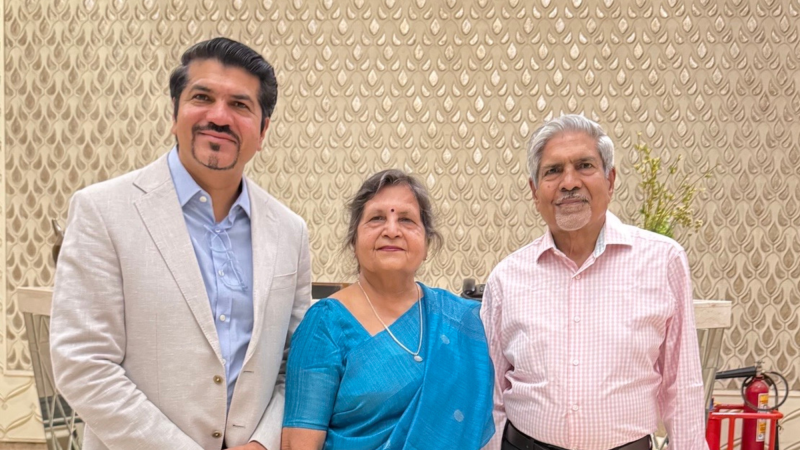
L-R (Amit Dixit, Shobha Dixit, Mahendra Kumar Dixit)
Amit Dixit with his parents Shobha Dixit and Mahendra Kumar Dixit
Disclosure: Our goal is to feature products and services that we think you'll find interesting and useful. If you purchase them, Entrepreneur may get a small share of the revenue from the sale from our commerce partners.
You're reading Entrepreneur Asia Pacific, an international franchise of Entrepreneur Media.
When Amit Dixit left India for graduate studies at Stanford University, a fellowship set up by John A. Blum helped cover the cost. He later attended Harvard Business School for his MBA. Twenty-five years after that, Blackstone’s head of Asia private equity has established a fellowship fund at Harvard Business School. The Shobha Dixit Fellowship Fund will provide financial assistance to MBA students at HBS.
“I hope to pay it forward by providing financial support to talented students who have the ability to excel but may lack the financial resources,” Dixit said in a statement. He said the Blum fellowship at Stanford “opened up a new world” for him, and that the HBS fund carries the same intent.
The fund was created on the occasion of Dixit’s 25-year HBS reunion. He has asked that, where possible, preference be given to students from India and to students who are also members of the Women’s Student Association, an organisation open to all students at HBS.
The fellowship is named after his mother, Shobha Dixit, whom he described as “an inspiration and a strong voice in the empowerment of women”.
The size of the gift was not disclosed.
For HBS, the gift adds to a financial aid structure that relies heavily on alum support. About half of MBA students receive need-based scholarships, with 10 per cent of students — those with the greatest financial need — receiving full-tuition scholarships. In fiscal 2025, the average need-based fellowship exceeded $47,000, according to HBS’s annual report, with the school allocating more than $52 million to financial aid.
“Support from alumni like Amit Dixit ensures that HBS can sustain need-based financial aid for students who come to the school from diverse international backgrounds,” said Srikant M. Datar, dean of Harvard Business School.
Students seeking fellowship support will apply through the standard HBS MBA admissions and financial aid process. The fund is intended to help students make career choices based on their interests and impact, rather than solely on the pressure to pay for business school.
The new fellowship fits into a broader pattern in Dixit’s philanthropy. In 2021, he supported the creation of IIT Bombay’s first chair exclusively for women faculty, aimed at funding research by outstanding women in science, technology, engineering and mathematics. IIT Bombay said at the time that the gift would also support recruiting initiatives to attract more women applicants.
That gift reflected his concern about the under-representation of women in STEM, a theme he is now carrying into management education through the HBS fellowship’s preference for Women’s Student Association members.
Dixit’s gift also places him among a small group of Indian business leaders making long-term philanthropic investments in talent at elite global institutions. He is described as the first Indian institutional investor to endow a fellowship at Harvard Business School, following in the footsteps of Blackstone’s founder, Steve Schwarzman, whose philanthropic giving to education — from MIT’s Schwarzman College of Computing to Oxford’s Schwarzman Centre for the Humanities — has set a benchmark for the firm’s leadership.
Dixit began his career at Trilogy Software before founding Automartindia, an online used car platform. He joined Warburg Pincus as a principal, focussing on technology, media and telecommunications investments, before moving to Blackstone in 2007. A graduate of IIT Bombay, where he received the Director’s Silver Medal for finishing at the top of his programme, he has led Blackstone’s investments across South Asia and global technology-enabled services as head of Asia for the firm’s private equity business.
Shobha Dixit, after whom the HBS fund is named, comes from a family deeply rooted in public service and education. She is the daughter of two freedom fighters. Her father served as a Cabinet minister in independent India, and her mother was a college dean. A science graduate from Kanpur University, she chose to dedicate herself to family and community. At 76, she remains a long-standing member of the Art of Living Foundation and a grandmother to four, all of whom are currently pursuing higher education.
When Amit Dixit left India for graduate studies at Stanford University, a fellowship set up by John A. Blum helped cover the cost. He later attended Harvard Business School for his MBA. Twenty-five years after that, Blackstone’s head of Asia private equity has established a fellowship fund at Harvard Business School. The Shobha Dixit Fellowship Fund will provide financial assistance to MBA students at HBS.
“I hope to pay it forward by providing financial support to talented students who have the ability to excel but may lack the financial resources,” Dixit said in a statement. He said the Blum fellowship at Stanford “opened up a new world” for him, and that the HBS fund carries the same intent.
The fund was created on the occasion of Dixit’s 25-year HBS reunion. He has asked that, where possible, preference be given to students from India and to students who are also members of the Women’s Student Association, an organisation open to all students at HBS.