Chips, Food and Telecom Anchor 4th India-Singapore Roundtable
The roundtable produced a food safety agreement and a telecom regulation LOI, alongside fresh discussions on semiconductor supplier entry, capital market links and aviation connectivity, as New Delhi presses ahead with a $13.3 Bn chip push.
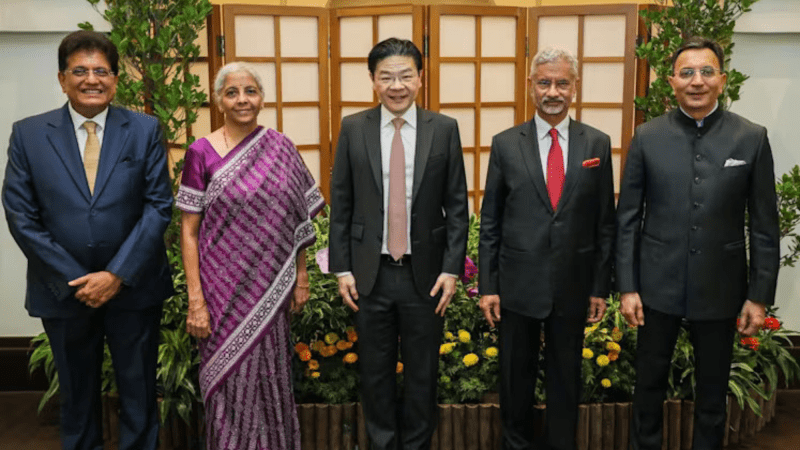
(L-R) India’s Commerce and Industry Minister Piyush Goyal, Finance and Corporate Affairs Minister Nirmala Sitharaman, Singapore Prime Minister Lawrence Wong, External Affairs Minister S Jaishankar, and Electronics and Information Technology Minister of State Jitin Prasada (Photo: Ministry of Digital Development and Information)
Opinions expressed by Entrepreneur contributors are their own.
You're reading Entrepreneur Asia Pacific, an international franchise of Entrepreneur Media.
Singapore is seeking to help homegrown semiconductor suppliers enter India’s expanding manufacturing ecosystem, putting company access and workforce training at the centre of the bilateral agenda as New Delhi has committed another $13.3 Bn to its chip programme.
The fourth India–Singapore Ministerial Roundtable, held in Singapore today (August 20), saw the two countries sign two MoUs covering food safety and maritime heritage, as well as a letter of intent (LOI) on telecommunications and broadcasting regulation.
Ministers also discussed deeper co-operation in semiconductors, food resilience, financial markets and aviation.
Semiconductors Lead the Agenda
India approved $13.3 Bn of fresh capital in July to expand its semiconductor programme. Under the original initiative, the government approved 12 manufacturing units and 24 chip design projects to reduce dependence on imported components and attract more of the global electronics supply chain.
Singapore offers a complementary industrial base. The city-state accounts for about one in 10 chips and one in five semiconductor manufacturing equipment units produced globally. It attracted more than S$30 Bn of semiconductor investment between 2022 and 2025.
The discussions, therefore, point to a potential division of roles. India provides a large market, policy incentives and manufacturing capacity while Singapore contributes equipment, specialised suppliers, technical expertise and links to global chipmakers.
The roundtable also discussed facilitating the entry of Singapore companies into India’s semiconductor ecosystem and establishing industry-led training centres. However, no company-specific investment commitments, locations, funding arrangements or implementation timetables were announced.
The semiconductor agenda rests on an already substantial commercial relationship. Indian government data put bilateral trade at $36.1 Bn in the financial year ended March 2026. FDI equity inflows from Singapore reached $19.8 Bn during the year, taking cumulative equity inflows between April 2000 and March 2026 to $194.68 Bn.
Capital Markets Build on Existing Links
The two sides also sought to widen their capital market links. Singapore Exchange and the National Stock Exchange of India are exploring additional derivatives, although neither disclosed any product or a launch timetable.
The proposal would build on the NSE–SGX GIFT Connect, which became fully operational in July 2023 and allows international investors to trade selected Indian equity derivatives through Gujarat International Finance Tec-City.
Digital payments form another part of the financial corridor. India’s Unified Payments Interface (UPI) is already linked with Singapore’s PayNow system. Both countries are also founding participants in Project Nexus, together with Malaysia, the Philippines and Thailand, although the meeting produced no new implementation date for the multilateral payments network.
Telecom Regulators Set a Co-operation Framework
The Telecom Regulatory Authority of India (TRAI) and Singapore’s Info-communications Media Development Authority (IMDA) signed the letter of intent on the sidelines of the roundtable. The signatories were Harinder Kumar, secretary of TRAI, and Aileen Chia, IMDA’s deputy chief executive for connectivity development and regulation and director-general for telecoms and post.
The arrangement establishes a channel for the regulators to exchange knowledge, expertise and regulatory experience in spectrum management, telecommunications-market regulation, consumer protection and technical innovation. It also covers co-ordination in international forums, particularly the International Telecommunication Union. Instead of introducing new commercial rules, the letter provides a framework for continued co-operation between the two authorities.
The exchange took place in the presence of Indian finance minister Nirmala Sitharaman, external affairs minister S Jaishankar, commerce and industry minister Piyush Goyal and minister of state for commerce and industry, Jitin Prasada.
Deputy prime minister and trade and industry minister Gan Kim Yong led Singapore’s delegation. Other participants included senior minister and home affairs minister K Shanmugam, foreign minister Vivian Balakrishnan, digital development and information minister Josephine Teo and transport minister Jeffrey Siow.
Food Safety and Supply Resilience
The food safety MoU provides for the exchange of information and best practices on food labelling, import procedures, product recalls, emergency notifications and shipments that are detained or rejected. It also provides for technical training and co-operation between food-safety authorities.
The MoU is regulatory, not a guarantee of food supplies or preferential market access. Separately, the two sides explored arrangements that could support continued food exports from India to Singapore during supply disruptions, but no food supply accord was signed.
The distinction matters for Singapore, which imports more than 90% of its food from more than 180 countries and regions. India’s scale as an agricultural producer makes it a potential resilience partner, while clearer safety procedures could reduce regulatory uncertainty for exporters.
Aviation and Emerging Technologies
Ministers also discussed aviation, pointing to the need for greater air connectivity as trade and investment grow between the two countries. Aviation authorities on both sides will follow up. The sector already has a significant corporate link through Singapore Airlines’ 25.1% stake in Air India.
The meeting also covered possible knowledge-sharing in space and civil nuclear technology, but no new agreement was announced in either field. Singapore has not decided whether to include nuclear power in its energy mix.
Taken together, the outcomes reflect an effort to turn established trade, investment and payment links into a broader operating corridor. The semiconductor proposals carry the greatest commercial potential. But their significance will depend on whether the two governments can convert discussions on supplier access and skills into named projects, committed investment and clear implementation schedules.
Singapore is seeking to help homegrown semiconductor suppliers enter India’s expanding manufacturing ecosystem, putting company access and workforce training at the centre of the bilateral agenda as New Delhi has committed another $13.3 Bn to its chip programme.
The fourth India–Singapore Ministerial Roundtable, held in Singapore today (August 20), saw the two countries sign two MoUs covering food safety and maritime heritage, as well as a letter of intent (LOI) on telecommunications and broadcasting regulation.
Ministers also discussed deeper co-operation in semiconductors, food resilience, financial markets and aviation.