Samsung’s Mistral Talks Could Give Europe’s AI Push a Powerful Chip Backer
The reported $1.1 Bn investment would deepen Samsung’s ties with the AI startup as Europe intends to build more of its own AI infrastructure.
Samsung
Opinions expressed by Entrepreneur contributors are their own.
You're reading Entrepreneur Asia Pacific, an international franchise of Entrepreneur Media.
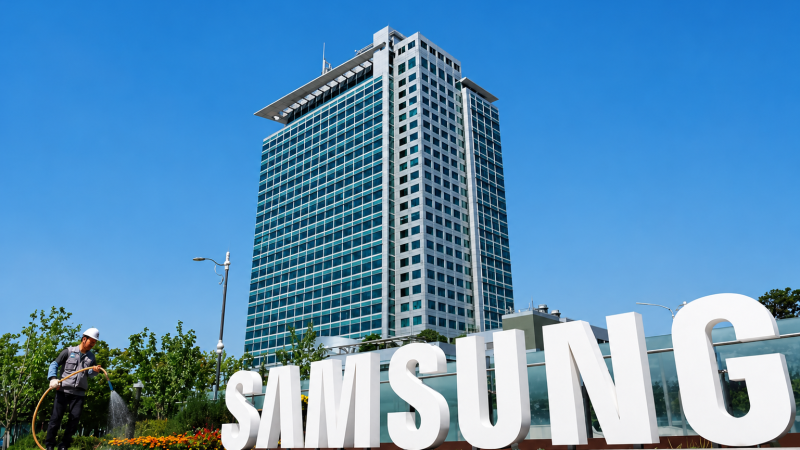
South Korean technology giant Samsung is in advanced talks to invest about €1 Bn ($1.14 Bn) in Mistral AI, a Paris-based developer of large language models and enterprise AI software, the Financial Times reported, citing people familiar with the discussions. Mistral’s technology is used to build AI assistants, autonomous agents and other generative-AI applications.
The proposed investment would form part of a wider fundraising that could value Mistral at roughly €20 Bn ($22.81 Bn), according to the report. Swedish investor EQT’s Scaleup Europe Fund is also in talks to participate.
Mistral is seeking to raise several billion euros overall, though the terms remain under discussion, the FT said. Reuters said it could not independently verify the report. Samsung and Mistral did not immediately respond to its requests for comment, and the eventual size, participants and valuation of the round could still change.
The significance of the potential deal extends beyond the money. Samsung’s reach across memory chips, semiconductor manufacturing and consumer devices could make it a valuable strategic partner for Mistral as the French company expands the computing infrastructure needed to train and deploy its models.
Samsung’s Recent AI and Deeptech Investments
| Date | Company | Round | Round Size* | Samsung’s Participation | Business Focus |
| July 2026 | OXMIQ Labs | Series A | $35 Mn | Samsung Catalyst Fund co-led the round with Fundomo | Licensable GPU and AI architecture |
| June 2026 | Zadar Labs | Series A | $17 Mn | Samsung Catalyst Fund participated | Imaging radar for physical AI and intelligent infrastructure |
| May 2026 | Anthropic | Series H | $65 Bn | Samsung participated as a strategic infrastructure partner | Foundation models and large-scale AI computing |
| March 2026 | Normal Computing | Strategic funding | $50 Mn | Samsung Catalyst Fund led the round | AI-based semiconductor design and energy-efficient computing |
| February 2026 | Axelera AI | Growth funding | More than $250 Mn | Samsung Catalyst Fund participated as an existing investor | Energy-efficient AI inference chips for edge computing |
Note: The amounts refer to the total size of each funding round. Samsung’s individual investment was not disclosed. The proposed Mistral investment has been excluded because the transaction has not been completed.
Samsung’s memory business recorded its highest quarterly revenue in January-March 2026 as demand increased for higher-value products used in AI systems. The company also began mass sales of its HBM4 high-bandwidth memory for Nvidia’s Vera Rubin platform and is expanding advanced foundry capacity for AI and high-performance computing customers.
The South Korean group has already invested in Mistral through its venture arm, according to the Financial Times. A commitment approaching €1 Bn would substantially deepen that relationship and make Samsung another major semiconductor company backing the French startup.
Dutch semiconductor equipment-maker ASML led Mistral’s previous funding round in September 2025, investing €1.3 Bn ($1.5 Bn) and taking an approximately 11% fully diluted stake. It also secured a seat on Mistral’s strategic committee under a long-term partnership intended to apply the startup’s models across ASML’s products, research, development and operations.
That Series C round raised €1.7 Bn ($2 Bn) at a post-money valuation of €11.7 Bn. A valuation of €20 Bn in the proposed new round would represent an increase of about 70% in less than a year, reflecting investor demand for one of the few European companies developing frontier AI models.
Samsung’s deal talks come as Mistral assembles a wider network of hardware, computing and distribution partners. Microsoft on Tuesday (July 21) announced a multibillion-dollar commitment to use part of Mistral’s expanding European computing infrastructure and make more of its models available through Microsoft Foundry, Copilot Studio and Azure.
The agreement will allow businesses to deploy Mistral models through public cloud services, customer-controlled systems and fully disconnected environments. Microsoft vice-chair and president Brad Smith told Reuters that the arrangement did not include a new equity investment.
For Mistral, the partnerships address the core constraint facing AI developers: access to enough chips, memory, electricity and data-centre capacity to train models and serve customers at scale. Although it remains far smaller than its US rivals, the company is trying to compete by offering businesses and governments a more integrated package spanning models, customised software and computing infrastructure.
Mistral raised $830 Mn in debt in March to buy 13,800 Nvidia chips for a data centre near Paris, its first debt financing. The company also announced a €1.2 Bn ($1.4 Bn) data-centre investment in Sweden and is seeking to secure 200 MW of computing capacity across Europe by the end of 2027.
Set up in 2023, Mistral allows companies to customise, fine-tune and deploy its models across private infrastructure, edge devices and cloud platforms. That flexibility has become an important part of its pitch to governments and regulated industries seeking more control over sensitive data and critical workloads.
The company supplies AI technology to the French armed forces and has positioned itself as a European alternative to the dominant US developers and cloud providers. Interest in such alternatives has grown as European governments and companies seek to reduce the risk of relying on technologies that are developed, hosted and governed largely outside the region.
Yet Europe’s AI push is not developing in isolation from global technology suppliers. Mistral’s data centres use US-designed Nvidia processors; Microsoft is extending its cloud distribution; ASML provides semiconductor-manufacturing expertise, and Samsung could add capital and memory-chip expertise.
The emerging model is, therefore, less about technological self-sufficiency than retaining greater control over where AI models are developed, deployed and operated. A deal with Samsung would strengthen that approach, giving Europe’s most prominent AI startup another powerful industrial partner as it tries to narrow the infrastructure gap with larger US rivals.
South Korean technology giant Samsung is in advanced talks to invest about €1 Bn ($1.14 Bn) in Mistral AI, a Paris-based developer of large language models and enterprise AI software, the Financial Times reported, citing people familiar with the discussions. Mistral’s technology is used to build AI assistants, autonomous agents and other generative-AI applications.
The proposed investment would form part of a wider fundraising that could value Mistral at roughly €20 Bn ($22.81 Bn), according to the report. Swedish investor EQT’s Scaleup Europe Fund is also in talks to participate.
Mistral is seeking to raise several billion euros overall, though the terms remain under discussion, the FT said. Reuters said it could not independently verify the report. Samsung and Mistral did not immediately respond to its requests for comment, and the eventual size, participants and valuation of the round could still change.