NEU Raises $7.6 Mn to Make Lithium Battery Recycling Pay
The Singapore cleantech company has opened a 1,300-tonne-a-year recycling plant as it attempts to solve a cost problem that has made one of the world’s fastest-growing battery technologies difficult to recycle profitably.
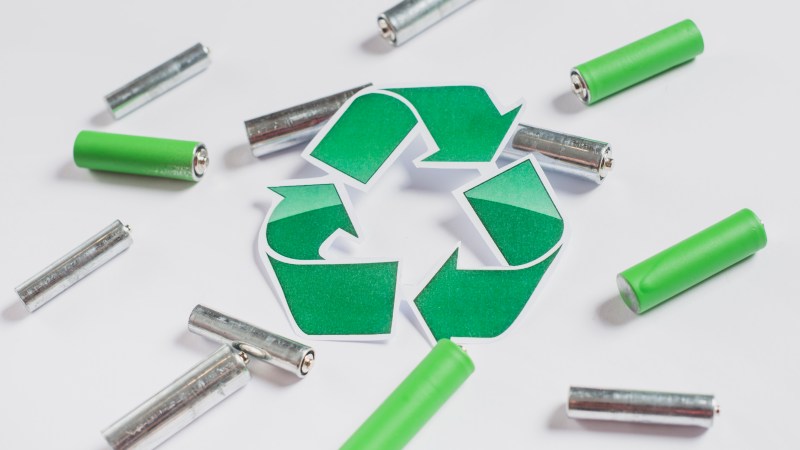
recycle icon batteries
You're reading Entrepreneur Asia Pacific, an international franchise of Entrepreneur Media.
Singapore’s NEU Battery Materials has raised $7.6 Mn to scale its lithium recycling technology, betting that a cheaper recovery process can turn one of the battery industry’s least attractive waste streams into a commercially viable source of critical minerals.
Shift4Good, a venture capital firm focussed on decarbonisation in transport and energy, and SGInnovate, Singapore’s government-backed deeptech investor, co-led the funding round, announced on October 13. New investors Lotus Singapore Group and M7 Holdings also joined existing backer Paragon Ventures I.
The investment coincides with the commissioning of NEU’s first industrial recycling plant in Tuas, Singapore, capable of processing 1,300 tonnes of battery materials annually. The company plans to use the funds to increase battery-grade lithium production, lower processing costs and expand overseas.
NEU’s investors supported its technology through several stages of development. The company raised $3.7 Mn in a 2023 seed round, with Shift4Good and SGInnovate among its early backers. In January 2026, it announced the first close of its pre-Series A funding to go beyond the pilot stage.
The October announcement described the $7.6 Mn round as ‘oversubscribed’ but did not provide a detailed breakdown.
The commercial opportunity lies in lithium iron phosphate (LFP) batteries, whose lower cost has accelerated adoption in electric vehicles (EVs) and energy storage. However, the same chemistry that makes LFP attractive to manufacturers also creates a problem for recyclers. Unlike nickel-rich batteries, LFP contains neither nickel nor cobalt, leaving fewer valuable metals to recover.
NEU is attempting to close that economic gap with a patented electrochemical process that uses electricity, water and reusable chemicals to extract lithium from battery manufacturing scrap and end-of-life materials.
The technology has progressed from laboratory development to a physical production facility. Whether it can operate profitably at larger volumes remains the more consequential test.
A Growing Market, Difficult Economics
LFP batteries accounted for more than 55% of EV batteries deployed globally in 2025, up from nearly 50% in 2024, according to the International Energy Agency’s (IEA) Global EV Outlook 2026.
Their appeal is largely economic. The IEA found that LFP battery packs were more than 40% cheaper on average than lithium nickel manganese cobalt oxide (NMC) alternatives in 2025, benefiting from lower-cost raw materials and manufacturing improvements. The agency noted that part of that difference reflects stationary storage, which mostly uses LFP and needs less energy density.
The chemistry has also become dominant in stationary storage, accounting for more than 90% of global battery storage installations last year.
For manufacturers, cheaper batteries support broader adoption. For recyclers, however, lower-value materials can make recovery less profitable.
Conventional recycling processes have traditionally benefited from extracting nickel and cobalt, metals whose sale can offset processing costs. LFP batteries offer no such revenue stream.
Lithium remains valuable, but recovering it from relatively low concentrations of material can be expensive. Chemical consumption, electricity, equipment and transportation costs all affect whether the recovered product can compete with newly produced lithium.
NEU’s approach is to reduce those processing costs.
Its electrochemical redox technology uses electricity and a membrane-based separation process to recover lithium from LFP materials. The company says it can reuse its regenerative chemicals, reducing reagent consumption compared with conventional hydrometallurgical recycling.
NEU claims the process can cut emissions by up to 83% compared with conventional recycling methods, including hydrometallurgy and pyrometallurgy. The figure is company-reported and does not establish the emissions performance of every industrial installation.
Nevertheless, the commercial proposition is intriguing. If recycling consumes fewer chemicals and produces less waste, NEU may recover lithium at a lower cost. But it has not disclosed its production margins or comparable unit-cost figures to establish that advantage at scale.
The Tuas Test
NEU’s new 12,000 sq. ft facility in Tuas represents a transition from developing recycling technology to testing its performance under industrial operating conditions.
Although the plant can process 1,300 tonnes annually, it will not initially operate at full capacity.
Co-founder and chief executive Bryan Oh told CNA that the Singapore facility would refine the process and develop an engineering blueprint for substantially larger overseas plants.
The company’s immediate operating challenge is securing sufficient battery material while validating the quality of its recovered lithium. About 85% of its current feedstock comes from battery manufacturing scrap instead of batteries that have reached the end of their useful lives. The distinction matters because many LFP batteries installed during the recent expansion of EVs and energy storage remain in operation. Large volumes have not yet entered the recycling market.
Manufacturing waste offers an earlier supply source, allowing NEU to process material generated during battery production rather than depend entirely on batteries being retired.
Oh told CNA that the company held about 40-50 tonnes of feedstock at its Singapore facility, mainly from overseas battery manufacturers. At its current processing rate, that inventory would last about six months.
Those volumes are well below the plant’s designed annual capacity, making material availability a key factor in its eventual utilisation.
Operating a recycling facility profitably requires more than efficiently recovering lithium. Processing equipment must receive enough material to justify its operating costs, while the recovered lithium must meet customers’ technical requirements.
From Waste to Battery-Grade Lithium
NEU’s technology processes manufacturing scrap and black mass, the powder recovered after shredding used batteries.
Its system extracts lithium hydroxide, which can then be processed into battery-grade lithium products. NEU also plans to supply lithium carbonate to battery manufacturers for use in new LFP batteries. The company is working with battery manufacturers to validate the quality and consistency of its recovered material, supplying progressively larger samples for testing.
Some of those manufacturers are also providing production scrap for NEU’s recycling process.
Such relationships could become central to its business model. Battery manufacturers generate waste during production while requiring lithium for new batteries. A recycler that can recover usable material from that waste could become both a waste-processing partner and a supplier.
The arrangement could give NEU more predictable feedstock and customers for its recovered lithium, even though product validation and operating economics will govern those commercial relationships.
The IEA has identified battery recycling as an important future contributor to critical mineral supply, while noting that retired batteries lag EV sales by roughly 15 years, with most packs staying in service until the mid-2030s or later.
NEU’s reliance on manufacturing scrap reflects that timing challenge.
The company must also contend with lithium prices. Lower prices for newly produced lithium could weaken the commercial case for recycling, while higher prices could improve the value of recovered material.
NEU has not disclosed contracted sales volumes, processing costs or profitability figures that would allow independent assessment of its current economics.
Scaling beyond Singapore
The next stage of NEU’s expansion could take it closer to the manufacturers supplying its raw materials.
Oh told CNA that the company was targeting Europe and the US in 2027, with plans to explore larger facilities developed alongside battery manufacturers. Locating recycling operations near battery production facilities could reduce transportation requirements and give NEU access to manufacturing scrap at source.
The company’s modular technology is intended to support replication at larger installations, although the performance and economics of those facilities remain to be demonstrated.
The expansion plans also come against a highly concentrated global battery supply chain. According to the IEA, China dominates the production of LFP cathode materials and their precursors, even as demand grows in other markets. The agency said an LFP production base is under construction in Indonesia in ASEAN.
Recovering lithium from manufacturing waste and retired batteries may eventually provide manufacturers with an additional source of supply. But recycling cannot replace newly produced minerals while battery installations continue to expand.
For NEU, the more immediate challenge is building a business that doesn’t rely solely on recycling’s environmental case. Its new plant must show it can produce consistent battery-grade material at costs customers will pay. Larger overseas facilities would then need to reproduce those results while securing sufficient feedstock.
The $7.6 Mn investment gives NEU capital to pursue that scale-up. But the decisive commercial milestone will be moving beyond proving that lithium can be recovered from LFP batteries to showing that the recovery process can make money.
Singapore’s NEU Battery Materials has raised $7.6 Mn to scale its lithium recycling technology, betting that a cheaper recovery process can turn one of the battery industry’s least attractive waste streams into a commercially viable source of critical minerals.
Shift4Good, a venture capital firm focussed on decarbonisation in transport and energy, and SGInnovate, Singapore’s government-backed deeptech investor, co-led the funding round, announced on October 13. New investors Lotus Singapore Group and M7 Holdings also joined existing backer Paragon Ventures I.
The investment coincides with the commissioning of NEU’s first industrial recycling plant in Tuas, Singapore, capable of processing 1,300 tonnes of battery materials annually. The company plans to use the funds to increase battery-grade lithium production, lower processing costs and expand overseas.

Entrepreneur Staff • Editor
Entrepreneur Staff
For more than 30 years, Entrepreneur has set the course for success for millions of... Read more