He Sold a Genetics Company. Now He Wants to Put a Skyscraper in Your Pocket.
Real estate is worth $393 trillion — more than every share, bond and bar of gold on earth combined — and almost no one is allowed to buy it in pieces. Entrepreneur-investor Avi Itzcovich, who built and sold a genetic-testing company and backed an artificial-intelligence business through to exit, believes blockchain tokenisation will finally break the world’s largest asset class into units anyone can own. He is building the venture to prove it.
.
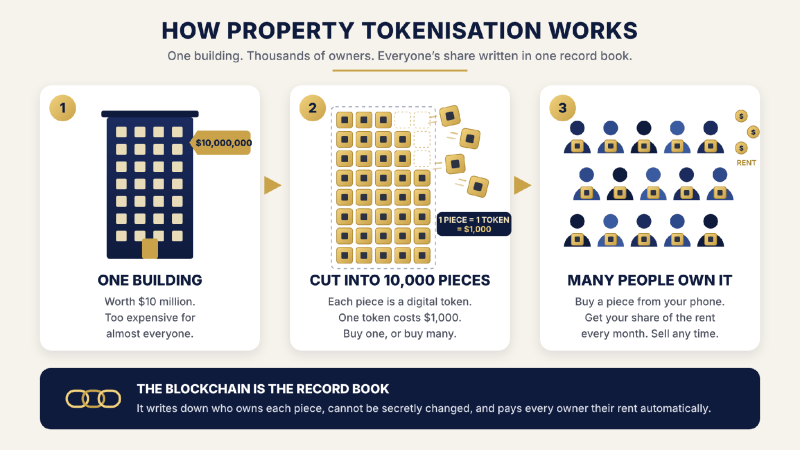
Tokenisation divides a single building into thousands of digital ownership units recorded on a shared ledger — bought in small amounts, traded in minutes, held by investors anywhere.
Opinions expressed by Entrepreneur contributors are their own.
You're reading Entrepreneur Asia Pacific, an international franchise of Entrepreneur Media.
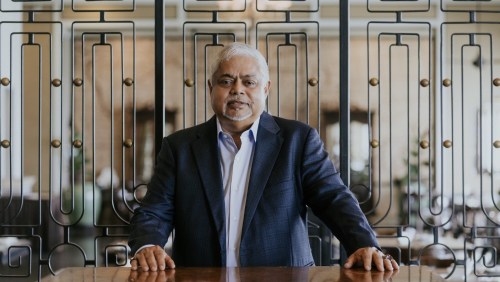
Ask Avi Itzcovich what a building is and he will not say bricks, or steel, or even an address.
“A building is a cash flow with a postcode,” he says. “The only reason you cannot buy a hundred dollars of one this afternoon is that we still record who owns it the way we did when the record was kept on parchment.”
It is a founder’s answer, and Itzcovich is a founder before he is anything else. He began investing in real estate in 2016, in Europe first and then the Middle East, and might have remained a property investor had his instincts not kept pulling him towards the one force property has always resisted: technology. He founded Original Gene, a direct-to-consumer genetic-testing company, built it into a significant success and sold it. He took a significant stake in iVMS Group, an artificial-intelligence business for vehicle management, and exited in 2025. Today he is an investor in Veyns, which is developing palm-based biometric authorisation for high-security environments, and he is building a blockchain-based venture to tokenise real estate — to divide property into digital units that can be bought, held and traded by people who could never have written a cheque for the whole.
Three industries, one pattern. “Genetics, vehicles, buildings — every business I have ever backed sells the same thing,” he says. “Certainty about something you cannot see. In property, the things you cannot see are who really owns what, what it is really worth and how quickly you could ever get your money out. Tokenisation answers all three.”
The largest market no one can trade
The numbers behind his conviction are not small. Savills values the world’s real estate at $393.3 trillion — more than global equities, debt and gold put together. Around three-quarters of it is residential: the homes of ordinary people, who are also the largest group shut out of the asset class as investors.
That exclusion is structural, not accidental. A property changes hands once every several years, in a transaction that takes months, carries fees that consume a meaningful slice of its value and requires the buyer to purchase all of it or none. The minimum ticket is a whole apartment. The exit is a sale. Between the two, the owner’s capital sits frozen in a form no one can split.
“The world’s biggest store of wealth has the worst user experience in finance,” Itzcovich says. “You can buy a fraction of a company in Singapore from your phone in four seconds. Try buying a fraction of the building that company sits in. In most of the world you still cannot — and that is not a law of nature. It is a filing system.”
What a token actually is
Strip away the jargon and real-estate tokenisation is simple. A property — or the company or fund that holds it — is divided into digital units recorded on a blockchain, a shared ledger that no single party can quietly alter. Each unit is a legally recognised share of ownership. Each can be bought in small amounts, moved between approved investors in minutes rather than months, and programmed with the rules that govern it: who is permitted to hold it, how rental income is distributed, when it may be resold.
Itzcovich’s own description is the one he gives investors. “Think of a share certificate that knows the rules,” he says. “It knows who is allowed to own it. It pays out its own rent every month. It cannot be forged, lost or quietly sold twice. And it settles in minutes, not weeks. Three things change — the size of the ticket, the speed of the exit and the honesty of the record. Everything else in this industry follows from those three.”
Where the value is created
This is the part that interests investors most, and where Itzcovich is at his most precise. Value in tokenised real estate, he argues, comes from five places.
The first is liquidity. Private assets trade at a discount because they are hard to sell; the day a fraction of a building can find a buyer in an afternoon, part of that discount disappears. The second is cost: the layers of administration and intermediation between a tenant’s rent and an investor’s return can be collapsed into code — Deloitte estimates that tokenisation can remove around $850 of cost for every $100,000 of mortgage originated, a small number per loan and an enormous one across a market. The third is access: when the ticket falls from a million dollars to a thousand, the pool of buyers grows by orders of magnitude, and a wider pool means sharper pricing. The fourth is composition: an investor can hold a hundred square metres spread across ten cities instead of one apartment on one street. The fifth, and the one he believes is least understood, is the capital stack itself. Developers can finance a project by selling tokenised fractions of it while it is still under construction, drawing on investors worldwide rather than a handful of banks.
The market appears to agree. Deloitte projects that tokenised real estate will grow from under $300 billion in 2024 to $4 trillion by 2035 — a compound rate of 27 per cent a year — with tokenised loans and securitisations the largest share at $2.39 trillion and private real-estate funds at $1 trillion.
“People hear ‘blockchain’ and think speculation,” Itzcovich says. “I hear ‘blockchain’ and think plumbing. The fortune in this is not in the token. It is in what the token removes — the friction, the waiting, the middlemen and the exclusion. That is where the returns come from, and they are real.”
Proof from the desert
For years the objection was that tokenised property existed only in white papers. Dubai has put an end to that argument.
In March 2025 the Dubai Land Department, in concert with the emirate’s Virtual Assets Regulatory Authority, launched the region’s first government-backed pilot for the tokenisation of property title deeds. The first tokenised property sold out within minutes to 224 investors — 70 per cent of them purchasing Dubai real estate for the first time — from a minimum ticket of AED 2,000, or roughly $545. Buyers came from more than 35 countries. One later project was fully funded in 118 seconds. In February 2026 the programme entered its second phase, opening a regulated secondary market upon which some 7.8 million property tokens may be resold. The Land Department expects tokenised real estate to reach AED 60 billion — about $16 billion — by 2033, or around seven per cent of all property transactions in the city.
Europe is the sterner examiner. The European Union’s Markets in Crypto-Assets regulation and its pilot regime for the trading of tokenised securities, together with Germany’s law on electronic securities, have built a framework within which a token may carry enforceable legal rights — slowly, deliberately, and with the investor protections that institutions rightly demand. Across Asia Pacific, Hong Kong’s regulatory sandbox for tokenisation, Singapore’s industry-wide pilots with the major banks and Japan’s fast-growing market in real-estate security tokens are doing likewise.
“Dubai is the proving ground and Europe the examination hall,” Itzcovich says. “Asia is where the demand resides. If a model survives the regulators of all three, it is no longer an experiment. It is infrastructure.”
A ledger requires a lock
There is one difficulty Itzcovich raises before any investor has the chance to. Once a building may be owned and transferred digitally, the most valuable thing in the entire system is no longer the building. It is the identity of the person authorised to move it.
This is why his investment in Veyns — palm-based biometric authorisation designed for such environments as financial services, transportation and critical infrastructure — is no departure from his real-estate thesis but its missing piece. “When ownership moves at the speed of a message, identity is the vault,” he says. “A password may be stolen. A private key may be copied. Nobody has ever phished a palm.”
It is what sets him apart from the crowd now gathering about tokenisation- he boasts a decade of experience in international property investment, a record of founding and exiting technology companies, and a stake in the identity layer and a tokenisation venture of his own. Few in the field have this kind of combined experience.
The rules he will not break
For all his confidence, Itzcovich is the opposite of a promoter. He is openly impatient with projects that have the technology and not the law.
“A token that is not tied to an enforceable legal title is a receipt for nothing,” he says. “I have three rules. No token without a title. No market without a regulator. No investor without identity. If a project cannot pass all three, I do not care how elegant the code is.”
He is equally candid about what remains unfinished: that secondary-market liquidity must be built deliberately rather than assumed, that valuations need credible anchors, that custody and tax treatment differ by jurisdiction, and that the frameworks of Europe, the Gulf and Asia do not yet speak to one another cleanly. “None of these is a reason to wait,” he says. “They are the work. The companies that do the work in the next five years will own the rails for the next fifty.”
Who gets to own the skyline
Ask him what success looks like and he does not talk about his own portfolio. He talks about a 28-year-old in Manila, Mumbai or Ho Chi Minh City who owns a slice of an office tower in Frankfurt, a share of a warehouse in Dubai and a fraction of a residential block in Lisbon — bought from a phone, paying rent every month, sellable in an afternoon.
“For a century, real estate has been the way the already-wealthy stayed wealthy,” he says. “Tokenisation is the first technology that can let everyone else in without lowering the standard of what they own. That is not a product. That is a correction.”
Buildings have always been the most solid thing we own. Avi Itzcovich’s wager is that the way we own them is about to become the most fluid — and that the people who understand this earliest will be the ones who build, finance and hold the next generation of the world’s cities.
Ask Avi Itzcovich what a building is and he will not say bricks, or steel, or even an address.
“A building is a cash flow with a postcode,” he says. “The only reason you cannot buy a hundred dollars of one this afternoon is that we still record who owns it the way we did when the record was kept on parchment.”
It is a founder’s answer, and Itzcovich is a founder before he is anything else. He began investing in real estate in 2016, in Europe first and then the Middle East, and might have remained a property investor had his instincts not kept pulling him towards the one force property has always resisted: technology. He founded Original Gene, a direct-to-consumer genetic-testing company, built it into a significant success and sold it. He took a significant stake in iVMS Group, an artificial-intelligence business for vehicle management, and exited in 2025. Today he is an investor in Veyns, which is developing palm-based biometric authorisation for high-security environments, and he is building a blockchain-based venture to tokenise real estate — to divide property into digital units that can be bought, held and traded by people who could never have written a cheque for the whole.
Covers capital flows, market structures, and the strategic thinking behind cross-border enterprises.