Malaysia Emerges as AI Hardware Hub with Investments Fuelling Growth
Semiconductor exports and a rapidly expanding data-centre pipeline are helping the economy outperform expectations and withstand the Middle East energy shock.
Magnific
Opinions expressed by Entrepreneur contributors are their own.
You're reading Entrepreneur Asia Pacific, an international franchise of Entrepreneur Media.
Malaysia is emerging as one of Asia’s leading artificial intelligence hardware hubs, with investment in semiconductors and data centres feeding into exports, construction and stronger-than-expected economic growth, a Bloomberg report said.
The country ranks alongside South Korea, Taiwan and Thailand as one of the world’s four largest net exporters of AI-related hardware, according to the International Monetary Fund (IMF). The group has been among the biggest beneficiaries of the global technology investment cycle as demand for chips, servers and other computing equipment accelerates.
Malaysia’s economy expanded 5.8% from a year earlier in the second quarter, beating the 5.2% median estimate in a Bloomberg survey and accelerating from 5.4% in the previous three months. Services remained the main growth driver, while manufacturing was supported by demand for electrical and electronic products.
The reading also lifted first-half growth to 5.6%, compared to about 4.5% a year earlier. JPMorgan subsequently raised its 2026 growth forecast for Malaysia to 5.3% from 5%, putting its estimate above Bank Negara Malaysia’s official range of 4-5%.
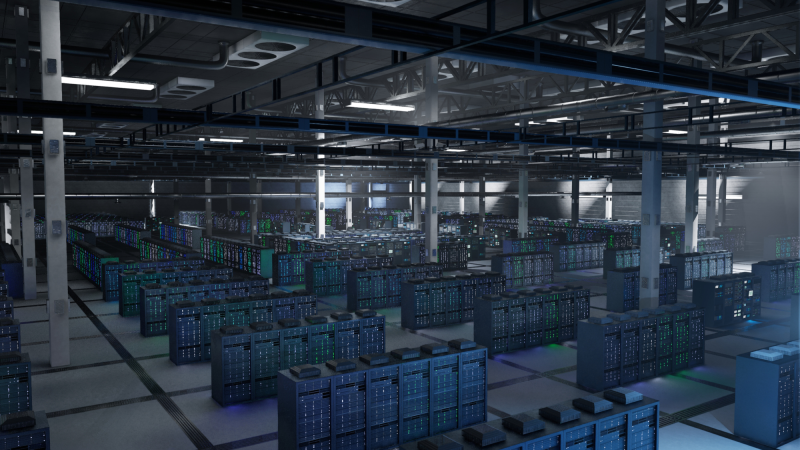
A surge in data centre construction has added another engine of investment. Malaysia’s data centre investment has reached nearly 18% of GDP, according to HSBC analysts, compared with 1-5% in most economies.
The Malaysian Investment Development Authority approved RM144.4 Bn of data centre and cloud computing investments between 2021 and mid-2025, reflecting the rush by global technology companies to secure land, power and computing capacity close to Singapore.
The investments cover different layers of the AI supply chain. German chipmaker Infineon has expanded semiconductor production in Kulim, while Nvidia is working with Malaysian conglomerate YTL on AI computing infrastructure. ByteDance, Microsoft, Amazon, Google and other technology giants have also committed capital to Malaysian data centres and cloud projects.
Malaysia’s attraction rests partly on an electronics industry built over more than five decades. Penang is a major centre for semiconductor assembly, testing and design, while the southern state of Johor has emerged as Asia’s fastest-growing data centre market after Singapore restricted new capacity.
Penang is seeking to expand that manufacturing base through Silicon Island, a 2,300-acre reclamation project intended to provide industrial land for semiconductor companies and other advanced manufacturers.
Gamuda, the Malaysian construction group involved in developing the island, said its order book reached a record RM52 Bn in June. Data centre contracts helped offset weaker activity in parts of its property and infrastructure businesses.
The investment boom has coincided with a broader improvement in Malaysia’s business standing. The country rose to 15th among 70 economies in the 2026 IMD World Competitiveness Ranking, from 23rd in 2025 and 34th two years earlier.
Malaysia also has an advantage over many of its regional peers as the Middle East conflict drives up energy costs. As a net exporter of oil and gas, the country receives some support from higher commodity prices, while energy importers such as Japan, South Korea and the Philippines face greater pressure on inflation and trade balances.
That buffer is not absolute. Bank Negara has warned that a prolonged conflict could weaken global demand and disrupt supply chains, but said stronger demand for electrical and electronic goods, higher tourism activity and an easing of geopolitical tensions could lift growth above its current forecast.
The rapid buildout is also increasing pressure on Malaysia’s electricity and water systems. Authorities have tightened scrutiny of new projects as communities and policymakers question the resource demands of facilities that consume large amounts of power but create relatively few permanent jobs, Reuters reported last month.
For now, investment approved over the past several years is beginning to translate into construction and industrial output. Ch’ng Cheng Siew, chief investment officer at Areca Capital, described 2026 as a turning point for Malaysia as that capital begins strengthening the economy’s productive base.
Malaysia is emerging as one of Asia’s leading artificial intelligence hardware hubs, with investment in semiconductors and data centres feeding into exports, construction and stronger-than-expected economic growth, a Bloomberg report said.
The country ranks alongside South Korea, Taiwan and Thailand as one of the world’s four largest net exporters of AI-related hardware, according to the International Monetary Fund (IMF). The group has been among the biggest beneficiaries of the global technology investment cycle as demand for chips, servers and other computing equipment accelerates.
Malaysia’s economy expanded 5.8% from a year earlier in the second quarter, beating the 5.2% median estimate in a Bloomberg survey and accelerating from 5.4% in the previous three months. Services remained the main growth driver, while manufacturing was supported by demand for electrical and electronic products.