Singapore Puts US Tariff Exposure at S$9.5 Bn as Chemicals, Optical Goods Face Levy
About one-third of domestic exports to the US are subject to the 12.5% tariff, while semiconductors, pharmaceuticals and several other high-value categories remain exempt.
Magnific
Opinions expressed by Entrepreneur contributors are their own.
You're reading Entrepreneur Asia Pacific, an international franchise of Entrepreneur Media.
Singapore estimated that the new 12.5% US tariff will apply to roughly S$9.5 Bn ($7.4 Bn) of its domestic exports to the US, or about a third of such shipments.
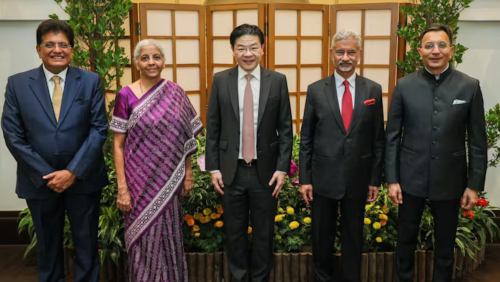
Deputy prime minister and minister for trade and industry Gan Kim Yong told parliament that the affected exports include optical instruments and chemical products.
Several of the city-state’s high-value export categories remain outside the tariff. Energy and energy products, semiconductors, pharmaceuticals, certain electronics and aerospace products are among the exemptions.
The S$9.5 Bn estimate shows the scale of a measure that Singapore had previously described as one-third of exports. It represents the value of affected shipments, not an equivalent loss to exporters. The eventual impact will depend on how much of the duty companies absorb, pass on through higher prices, or how it translates into weaker US demand.
The tariff took effect on July 24 after Washington cited Singapore’s lack of explicit prohibition on imports made using forced labour, as Entrepreneur Asia Pacific reported earlier. It was imposed under Section 301 of the US Trade Act of 1974, a provision that lets Washington act against foreign trade practices it deems unfair.
For companies whose products are covered, the levy raises the cost of entering the US market and could pressure margins, pricing and contracts.
The action comes despite the US running a $3.6 Bn goods trade surplus with Singapore in 2025, underscoring that the measure is tied to Washington’s forced-labour trade policy rather than a bilateral trade deficit.
Singapore is in talks with the US, but Gan signalled that the government would not look at tariff relief in isolation. Any agreement could involve commitments beyond an import prohibition, including export controls or restrictions relating to third countries, he said.
That has wider implications for a trading hub whose annual goods and services trade amounts to about S$2.5 Tn, including S$1.4 Tn in goods. For Singapore, the calculation is, therefore, not simply whether it can secure a lower tariff on S$9.5 Bn of exports, but whether that could require commitments affecting the much larger trade flows that pass through the economy.
Singapore estimated that the new 12.5% US tariff will apply to roughly S$9.5 Bn ($7.4 Bn) of its domestic exports to the US, or about a third of such shipments.
Deputy prime minister and minister for trade and industry Gan Kim Yong told parliament that the affected exports include optical instruments and chemical products.
Several of the city-state’s high-value export categories remain outside the tariff. Energy and energy products, semiconductors, pharmaceuticals, certain electronics and aerospace products are among the exemptions.