TCS to Buy Porsche’s MHP for €320 Mn Alongside €1.25 Bn AI Deal
The Indian IT giant will take over the 4,500-person automotive consultancy as Porsche moves from owner to anchor client under a five-year services commitment spanning manufacturing, engineering and software-defined mobility.
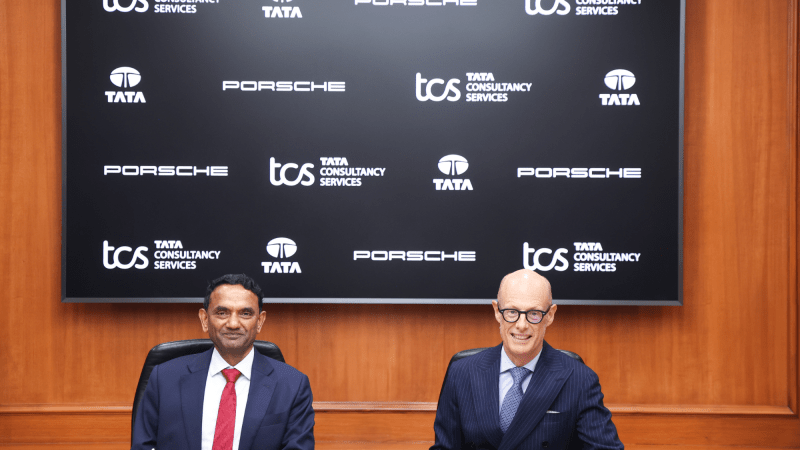
(L-R) K. Krithivasan, CEO and Managing Director, Tata Consultancy Services & Dr. Michael Leiters, CEO, Porsche AG
Opinions expressed by Entrepreneur contributors are their own.
You're reading Entrepreneur Asia Pacific, an international franchise of Entrepreneur Media.
Tata Consultancy Services (TCS) will acquire MHP Management- und IT-Beratung GmbH, Porsche AG’s management and IT consultancy, for an enterprise value of €320 Mn ($373 Mn), alongside a five-year, €1.25 Bn ($1.46 Bn) technology agreement aimed at deploying artificial intelligence across the German sports car maker’s value chain.
Tata Consultancy Services Netherlands B.V., a wholly owned TCS subsidiary, has signed a share purchase agreement to acquire 100% of MHP in cash. The enterprise value excludes customary adjustments for net debt and working capital, according to TCS’s stock-exchange filing.
The acquisition is expected to close within three to four months. It requires clearance from the European Commission under the European Union’s merger-control rules and Foreign Subsidies Regulation, foreign investment approval in Romania and a certificate of non-objection from Germany’s Federal Ministry of Economy and Energy.
Under the accompanying commercial agreement, Porsche has committed €1.25 Bn over five years to TCS and MHP.
TCS will establish a dedicated AI mobility centre of excellence to develop and scale applications across Porsche’s manufacturing, engineering, operations, customer experience and wider enterprise transformation.
The companies said the work would extend to next-generation automotive technology services and software-defined mobility platforms. The centre will be expected to move AI use cases beyond experimentation into secure, scalable deployment, although neither company identified the first applications, implementation targets or expected savings.
Porsche said MHP will retain its name and operate as an independent consultancy after the sale. The carmaker will remain an important client, particularly for AI, digitalisation and transformation work, while TCS intends to use MHP’s specialist position to reach more European automotive and industrial customers.
“Together, we will industrialise AI at scale for Porsche,” TCS chief executive and managing director K. Krithivasan said, adding that the combination would bring together TCS’s AI, engineering and business transformation capabilities with MHP’s automotive consulting expertise.
Porsche’s chief executive Michael Leiters described the transfer as a step towards concentrating on the company’s core business. The arrangement, he said, would allow Porsche to combine its automotive knowledge with TCS’s technology and AI capabilities as software and data become more important to mobility.
MHP, whose initials are derived from its original name, Mieschke Hofmann und Partner, was founded in 1996 by Lutz Mieschke and Ralf Hofmann. The consultancy has about 4,500 employees and works across business transformation, AI, SAP, digitalisation of factory operations, connected mobility, cybersecurity and software-defined products. Its customers span the automotive, manufacturing, aerospace, defence, energy and public sectors. MHP says it serves around 300 clients worldwide.
The consultancy generated €742 Mn in turnover in 2025, down 10.6% from €830 Mn in 2024, after reporting €828 Mn in 2023, according to an exchange filing. Deutsche Bank advised TCS on the transaction, while Noerr acted as its legal counsel.
Why Auto Groups Sell Their Tech Units to IT Firms
The acquisition-plus-contract structure has clear precedents in the automotive industry. It allows an automotive group to transfer a technology operation to a specialist provider without losing access to its capabilities. The buyer gains industry expertise, employees and external clients, supported by a long-term contract from the former parent. The automotive group, meanwhile, converts an internally owned capability into an outsourced service and focusses on its core operations.
Volvo Group used the model in 2016 when it sold its external IT operation and related assets to HCL Technologies and outsourced its IT infrastructure to the Indian company. The acquisition was announced at $138 Mn, or SEK 1.1 Bn. HCL took on about 2,500 employees and added 40 external customers, according to its financial statements and management disclosures. Volvo did not disclose the value of the accompanying outsourcing contract.
Wipro followed a similar automotive sector playbook in 2025, paying $375 Mn for Harman’s digital transformation solutions business. More than 5,600 employees moved with the engineering and digital services unit, while Wipro signed a multiyear strategic agreement with the automotive-electronics supplier Harman and its parent, Samsung. The companies did not disclose the contract value.
The TCS-Porsche arrangement is, therefore, not unique. Its distinguishing features are the disclosed €1.25 Bn customer commitment, the explicit mandate to apply AI across the mobility value chain and MHP’s position as an established external consultancy rather than a purely captive technology unit. Porsche is relinquishing ownership of a long-standing digital supplier but retaining access through a contract. TCS receives automotive expertise, a German client base and an anchor customer.
Porsche Sells MHP Amid a 93% Profit Drop and Wider Cost Cuts
The disposal forms part of Porsche’s restructuring strategy through 2035, which it calls Sportwagenschmiede 35. The programme aims to strengthen profitability, cash flow and resilience by sharpening Porsche’s focus on its brand, customers and products while streamlining the organisation. Porsche folded its standalone Car-IT division into research and development on July 1 and has been cutting costs and closing non-core operations as it contends with weaker demand in China, tariffs and the cost of resetting its EV strategy.
The reset follows a steep deterioration in 2025. Porsche’s revenue fell 9.5% to €36.27 Bn and operating profit dropped 92.7% to €413 Mn, taking its operating return on sales from 14.1% to 1.1%. The first half of 2026 showed an improvement, though. Operating profit rose 33.9% to €1.35 Bn and the margin recovered to 7.8%. But revenue still declined 5.1% to €17.23 Bn and vehicle deliveries fell 16.5%, leaving the company under pressure to extract more from a smaller sales base.
The sale reverses a relatively recent ownership decision. Porsche, which had held 51% of MHP since 1998 and raised its stake to 81.8% in 2011, acquired founder Ralf Hofmann’s remaining 18.2% by January 2024. At the time, it said full ownership would help MHP expand outside the group and that the consultancy was open to acquisitions. Within three years, Porsche is transferring the business to a global technology services owner.
For TCS, the five-year Porsche agreement provides a substantial revenue foundation around the acquisition. Spread evenly, €1.25 Bn would amount to €250 Mn a year, equivalent to about 34% of MHP’s 2025 turnover. The comparison is only indicative. The companies have not disclosed how the contract will be divided between TCS and MHP, how spending will be phased, how much of the contract covers services Porsche already purchases from MHP, or how much represents new business.
At €320 Mn, TCS is valuing MHP at about 0.43 times its 2025 turnover. But the relevance of that multiple depends on MHP’s profitability and customer mix, neither of which has been disclosed.
The signed €320 Mn enterprise value sits well below the potential valuation of more than €1 Bn reported by Handelsblatt when Porsche was considering a sale in June 2025, according to Reuters. The earlier figure was preliminary and no sale mandate had then been awarded. So, it cannot be directly compared with the signed transaction.
MHP’s profitability, customer concentration and net-debt position were not disclosed in the transaction filings, preventing a firm conclusion about whether TCS is acquiring the business cheaply.
The strategic fit is clearer. Manufacturing accounted for 8.7% of TCS’s revenue in the June quarter, while Continental Europe contributed 15.4%. MHP adds specialised automotive knowledge and consulting capacity in both areas as European carmakers seek to lower costs and improve their capabilities in software, connected vehicles and AI-enabled manufacturing.
The acquisition also extends a shift in TCS’s capital strategy. In December, the company agreed to acquire Salesforce consultancy Coastal Cloud for an announced consideration of $700 Mn and completed the transaction in January. TCS has also said it is evaluating acquisitions in AI, data security and cybersecurity. Its annualised AI revenue reached $2.6 Bn in the June quarter, up 13.6% sequentially, while total quarterly revenue increased 2.7% year on year to $7.62 Bn.
The test will be whether TCS can preserve MHP’s specialist culture and relationships with its automotive clients while using its global delivery scale to expand the consultancy. Porsche, in turn, must show that transferring ownership does not weaken the software and institutional knowledge it needs to compete. The five-year commitment keeps the two companies closely tied. But the deal’s success will ultimately depend on whether that spending produces faster deployment and measurable operating gains rather than simply changing who invoices Porsche for the work.
Tata Consultancy Services (TCS) will acquire MHP Management- und IT-Beratung GmbH, Porsche AG’s management and IT consultancy, for an enterprise value of €320 Mn ($373 Mn), alongside a five-year, €1.25 Bn ($1.46 Bn) technology agreement aimed at deploying artificial intelligence across the German sports car maker’s value chain.
Tata Consultancy Services Netherlands B.V., a wholly owned TCS subsidiary, has signed a share purchase agreement to acquire 100% of MHP in cash. The enterprise value excludes customary adjustments for net debt and working capital, according to TCS’s stock-exchange filing.
The acquisition is expected to close within three to four months. It requires clearance from the European Commission under the European Union’s merger-control rules and Foreign Subsidies Regulation, foreign investment approval in Romania and a certificate of non-objection from Germany’s Federal Ministry of Economy and Energy.