Inside Anthropic’s NASDAQ IPO as Revenue Soars and Compute Bills Stretch to 2045
The GenAI company’s landmark filing shows a 14-fold revenue surge and its first quarterly operating profit, set against an $80.75 Bn net loss driven mainly by valuation-linked accounting charges. The prospectus sets up a high-stakes test of whether volatile enterprise demand can sustain decades of infrastructure commitments at a company its founders control.
Anthropic
Opinions expressed by Entrepreneur contributors are their own.
You're reading Entrepreneur Asia Pacific, an international franchise of Entrepreneur Media.
Anthropic PBC, the San Francisco-based developer of the Claude AI models, has formally launched what promises to be a watershed moment for Silicon Valley and global capital markets. The company filed its Form S-1 registration statement with the U.S. Securities and Exchange Commission (SEC) on Oct. 26, outlining plans to go public on the NASDAQ Global Select Market under the ticker symbol ANT.
The upcoming offering is poised to test the upper limits of public-market appetite for generative AI. The Wall Street Journal has reported that the blockbuster flotation could raise $100 Bn or more, with a listing target pencilled in for the week of November 16. Goldman Sachs and Morgan Stanley are leading a syndicate of 22 banks in a transaction in which both the company and its existing shareholders will sell shares. The share count and price range have not yet been set, but the listing will let public investors price a pure-play frontier AI developer directly.
Anthropic says it will use the proceeds for general corporate purposes, including investing in compute and infrastructure, hiring and covering tax withholding on employee share awards that settle at the listing.
Anthropic’s IPO at a Glance
| Key Metric | Details |
| Issuer | Anthropic, PBC, a San Francisco-basedpublic benefit corporation |
| Filing | Form S-1 filed with the U.S. SEC on Oct. 26, 2026 |
| Listing | NASDAQ Global Select Market, ticker ANT |
| Sellers | Anthropic and existing shareholders |
| Lead underwriters | Goldman Sachs, Morgan Stanley |
| Shares and price range | Not yet disclosed |
| Last private valuation | $965 Bn, May 2026 |
| Cash, cash equivalents and short-term investments | $131.7 Bn as of June 30, 2026 |
| Voting control | Co-founders retain 50.1% of general voting power through one Class F share held by Founder LLC; Long-Term Benefit Trust elects a board majority. |
Sources: Anthropic Form S-1, filed with the U.S. SEC on Oct. 26, 2026; Anthropic Series H funding announcement, May 28, 2026
Under the Hood: Hypergrowth Meets Its First Operating Profit
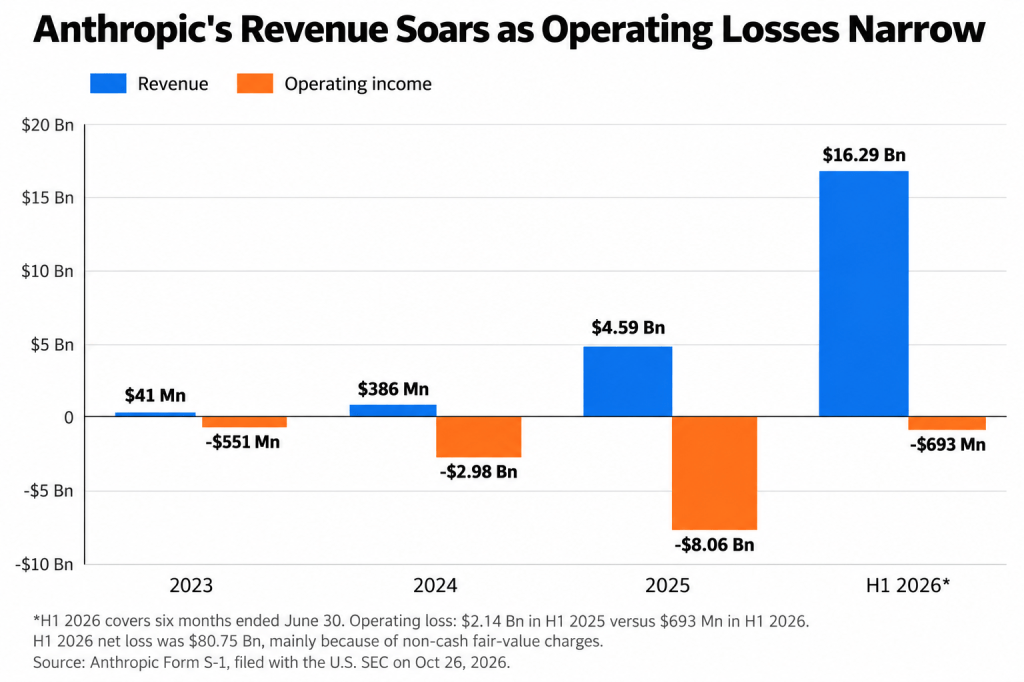
The filing shows how quickly demand for Anthropic’s GenAI models has grown. Revenue reached $16.29 Bn in the six months to June 30, fourteen times the $1.16 Bn posted a year earlier. That is more than three times Anthropic’s $4.59 Bn revenue in 2025, up from $386 Mn in 2024. Its Q2 2026 revenue of $11.56 Bn alone exceeded everything Anthropic booked from 2023 to 2025.
The growth has carried Anthropic to operating profitability. It posted $974 Mn in operating income in the second quarter, after a $1.67 Bn operating loss in the first. It was the company’s first operating profit in the six quarters covered by the filing. The first-half operating loss also narrowed to $693 Mn from $2.14 Bn a year earlier.
On an adjusted basis, which excludes items such as stock-based compensation and non-cash charitable contributions, Anthropic posted $1.62 Bn in operating income in the first half, or 10% of revenue, versus an adjusted loss of $1.85 Bn a year earlier. The adjusted figure is not a measure of profit under generally accepted accounting principles.
The pace, though, is starting to ease. The filing does not give a third-quarter revenue figure, but it says revenue in the three months to Sept. 30 was 86 times the December 2024 quarter’s $197 Mn, or about $16.9 Bn by our calculation.
The Financial Times reported that Anthropic told investors the figure was $16.8 Bn. In either case, the third quarter added fewer new dollars of revenue than the second, the first time this has happened in the quarters disclosed. Anthropic expects its growth rate to decline over time and to fluctuate from period to period.
Its net loss, however, was far larger than its operating loss, at $80.75 Bn for the first half of 2026. The filing attributes most of it to non-cash accounting charges. As Anthropic’s valuation rose, so did the value of the convertible notes and similar instruments it issued to investors, and the company books that increase as a loss.
Revenue-loss Bar chart
Compute Costs Fall as a Share of Revenue
For investors, the essential question is whether Anthropic’s revenue can keep outpacing the cost of the computing power needed to train and run its models. Computing and infrastructure expenses nearly quadrupled to $8.95 Bn in the first half of 2026, from $2.33 Bn a year earlier.
Revenue, though, grew much faster. Computing costs fell to 55% of revenue in the first half, from about 200% a year earlier and to 48% in the second quarter alone. In that quarter, revenue rose 1,368% YoY while compute and infrastructure expenses rose 300%. Anthropic presents this as evidence of its compute efficiency. Much of the improvement came as revenue outgrew capacity Anthropic had contracted earlier. But as new capacity comes online and short-term compute gets pricier, costs could rise again and weigh on margins, the filing warns.
Anthropic’s lean model also shows up in its headcount. Revenue per employee over the 12 months to Sept. 30 exceeded $6.6 Mn, up from $1.4 Mn a year earlier, on a workforce of about 5,300, up from about 940 as of Dec. 31, 2024. Among the Magnificent Seven tech groups, only Nvidia brings in more, about $7.2 Mn per employee, according to Yahoo Finance. At the $1.5—$2 Tn valuation reportedly under discussion, Anthropic’s investors would be paying $283—$377 Mn per employee, two to three times Nvidia’s $121 Mn.
The question for investors is whether those gains hold as each new model generation demands more computing power to train.
The $80.7 Bn Loss: An Accounting Distinction
Most of Anthropic’s net loss is an accounting effect of how it raised money privately. Of the $80.75 Bn first-half loss, $72.39 Bn came from non-cash changes in the fair value of its convertible notes, derivative liabilities and simple agreements for future equity (SAFEs). The filing says these were driven mainly by its convertible promissory notes, whose value rose with Anthropic’s valuation, which reached $965 Bn in its May funding round.
Other expenses amounting to $8.76 Bn were partly offset by $1.11 Bn of interest income. The cash-flow statement treats $8.72 Bn of those expenses as a non-cash charge on other financial instruments, separate from the $72.39 Bn. So, the headline loss does not reflect an equivalent amount of cash leaving the business.
Cash generation has turned positive. Operating cash flow was $3.93 Bn in the first half, up from an outflow of $1.51 Bn a year earlier. Still, management says part of the improvement reflects timing differences in customer receipts and supplier payments. As of June 30, Anthropic held $112.4 Bn in cash and cash equivalents and $19.3 Bn in short-term investments, having raised $141.1 Bn in total.
That cushion will be tested, though. Anthropic expects significant upfront payments for its infrastructure build-out before facilities become operational, and substantial net cash outflows from operating and investing activities for the foreseeable future. Those cash needs may grow even if its financial performance improves, the filing says. The company thinks it has liquidity to cover its requirements for at least 12 months, but it may need more financing as it expands.
Compute Bills That Run to 2045
Anthropic’s growth depends on buying computing capacity years ahead of demand, and its commitments are vast. Fortune counted more than 580 instances of the word “compute” in the filing. As of June 30, Anthropic had about $265.6 Bn in minimum purchase commitments and $321.4 Bn in leases that had not yet begun. Since then, it has signed or amended agreements worth about $245 Bn, with commitments stretching to 2045.
Its largest cloud contracts commit Anthropic to spend a minimum of about $114.5 Bn with Google until 2033, at least $110 Bn with Amazon until 2036 and at least $44.9 Bn with Microsoft until 2033. The company has also agreed to buy up to $120.5 Bn of Nvidia-powered capacity from Elon Musk’s SpaceXAI until 2029. Once all of this capacity is delivered, which is expected in December 2026, monthly payments will reach about $3.1 Bn.
Anthropic’s largest single obligation is to the chipmaker Broadcom, driven by five-year leases for Google-designed TPU chips. These agreements, non-cancellable except in the event of default, carry aggregate rent of $161.2 Bn (excluding interest), which Anthropic pays quarterly as the equipment comes online. To help fund these massive leases, Broadcom has agreed to lend Anthropic up to $42 Bn through convertible notes. In other words, the chip supplier is doubling as the customer’s banker.
Meanwhile, the same tech giants supplying this computing power also distribute Anthropic’s models. Cloud marketplaces run by Amazon Web Services, Google Cloud and Microsoft Azure handled 48% of Anthropic’s first-half revenue, a massive leap from just 11% in 2023. These platforms collect customer payments and pass them to Anthropic after deducting their fees. In fact, a $2.7 Bn spike in these channel partner fees drove Anthropic’s sales, marketing and partnership costs up to $3.17 Bn.
Amazon and Google are also major equity investors, with each expected to hold more than 5% of the capital stock after the IPO. However, their stakes are capped. Amazon’s notes cannot convert into a stake above 12%, and Google’s 2026 investment agreement limits its holding to 14.99%, unless either company waives the restriction. Google also holds an option to purchase up to $10 Bn in shares alongside the IPO.
Ultimately, Amazon and Google extract value simultaneously as Anthropic’s landlord, shopkeeper and shareholder.
That leaves investors to weigh a critical structural mismatch. Much of Anthropic’s revenue lacks long-term customer commitments, yet many of its infrastructure contracts require payments for years, even for capacity it may not use. Compounding this risk, the filing warns that agent-based applications—where AI independently executes multi-step tasks—can consume far more computing power than standard queries. This makes its computing needs harder to forecast.
Running its work across Amazon’s Trainium chips, Google’s TPUs, and Nvidia and AMD GPUs lets Anthropic shift workloads to where they run best, but it still depends heavily on its cloud partners’ capacity and pricing. Over time, it expects more of its spending to go into building its own computing infrastructure.
This tension extends far beyond Anthropic. The IPO arrives as markets intensely scrutinise whether massive AI capital expenditures are generating matching customer demand and cash returns. Concerns over returns on AI investment contributed to a sharp selloff in U.S. technology stocks on Oct. 22, Reuters reported.
Is Enterprise Growth Sustainable?
Anthropic’s top-line growth is heavily anchored to consumption-based fees, which accounted for about 80% of its first-half revenue this year, with subscriptions making up the remainder. This reliance on usage exposes the company to sudden churn. Many of its biggest clients lack long-term commitments or hold contracts nearing expiry, leaving them free to scale back or halt spending at will.
As of June 30, the deeptech firm reported $10.8 Bn in remaining performance obligations, the value of contracted services yet to be delivered. While Anthropic expects to recognise roughly 75% of this backlog within the next 12 months, it is increasingly securing its long-term outlook. A growing cohort of enterprise clients are signing non-cancellable annual or multi-year agreements, committing to minimum spending levels in return for locked-in pricing. This shift gives the company a much more predictable revenue stream.
Ultimately, sustaining this trajectory depends less on legal contracts than on Claude’s ability to maintain a competitive edge in both performance and pricing.
Compounding these commercial pressures is a volatile regulatory battle in Washington. In February, President Donald Trump directed federal agencies to stop using Anthropic’s technology. The directive followed the company’s public stance that its models would not be used for mass domestic surveillance or fully autonomous weapons systems, prompting the Department of War to designate the startup a supply-chain risk.
The legal fallout has been mixed. A California federal court largely ruled in Anthropic’s favour on Aug. 27, but a D.C. Circuit panel upheld one of the government designations in a 2-1 vote on Sept. 25. Anthropic has since petitioned for an en banc rehearing before the full D.C. Circuit.
Although direct government contracts account for a mere 1% of total revenue, the prospectus warns that the dispute also exposes corporate customers who do business with the federal government.
Anthropic’s Enterprise Boom: Explosive Growth but Revenue Risks Persist
The number of customers generating at least $100,000 each in annual revenue surged from about 20 in 2023 to more than 11,900 by September 2026. But dependence on a few major customers—around 25% of revenue came from five customers in the first nine months of 2026—as well as spending volatility and regulatory restrictions could affect that growth.
Enterprise Customer Growth
| Key Metric | 2023 | 2024 | 2025 | Sept 2026 |
| Customers generating $100,000+ in trailing 12-month revenue | About 20 | About 200 ↑ ~900% | About 1,500 ↑ ~650% | Over 11,900 ↑ >690% |
| Revenue from the above category | $37 Mn | $220 Mn ↑ ~495% | $3.5 Bn ↑ ~1,490% | N/A |
| Customers generating $1 Mn+ in trailing 12-month revenue | N/A | N/A | N/A | Over 1,900 |
| Customers generating $10 Mn+ in trailing 12-month revenue | N/A | N/A | N/A | About 250 |
| Net revenue retention | N/A | N/A | N/A | About 900% |
Source: Anthropic Form S-1, filed with the U.S. SEC on Oct. 26, 2026, Management’s Discussion and Analysis
Note: Customer counts reflect trailing 12-month revenue, measured as of December 31 for 2023–2025 and September 30 for 2026. Growth percentages are approximate, calculated from rounded figures against the preceding column. The 2026 increase covers nine months, not a full year. Customer categories overlap. Net revenue retention excludes Claude Pro and Max subscribers. N/A indicates figures not disclosed.
What Could Hit Enterprise Growth
| Risk | What the SEC Filing Reveals | Business Implications |
| Seasonal dip in spending | Customer spending fell about 20% in the two weeks ended Jan. 2, 2026, compared with the preceding fortnight. | Lower business activity during the Christmas, New Year or other festivities can reduce Claude usage and temporarily affect Anthropic’s revenue. |
| Dependence on major customers | One customer accounted for 11% of H1 2026 revenue, but no individual customer exceeded 10% in the first nine months. | Losing a major customer or a substantial portion of its business could hurt revenue, although Anthropic’s customer base is broadening. |
| Cloud platform dependence | Sales through AWS, Google Cloud and Azure marketplaces generated 48% of H1 2026 revenue, up from 11% in 2023. | Disruptions involving major cloud partners could affect sales, customer access and costs. |
| Revenue from customers violating company policies | Anthropic estimates that 5–7% of revenue in the first nine months of 2026 came from customers subsequently found violating its usage policies or commercial terms. | Stricter enforcement could reduce future revenue, although the financial impact remains uncertain. |
| Competition and pricing pressure | Rival providers, including those offering lower-cost and open-weight models, compete for enterprise customers. | Anthropic may have to cut prices or risk losing customers if rivals offer comparable performance at lower cost. |
| Export restrictions | U.S. authorities restricted access to Anthropic’s Fable 5 and Mythos 5 models in June 2026, forcing the company to temporarily disable both for all customers. The restrictions were subsequently lifted. | Further restrictions could interrupt sales, prevent customers from accessing models and drive them towards competitors. |
| Regulatory and legal scrutiny | In October 2026, the US Federal Trade Commission sought information about Anthropic’s consumer protection, data privacy and AI product safety practices. Anthropic is also contesting a U.S. government designation of the company as a national security supply-chain risk. | Regulatory action could raise legal costs, require changes to products or restrict sales to government agencies and their contractors. |
Source: Anthropic Form S-1, filed with the U.S. SEC on Oct. 26, 2026, Risk Factors, Management’s Discussion and Analysis and Notes to Consolidated Financial Statements
Note: The 5–7% figure is Anthropic’s estimate, not a forecast of lost revenue. The holiday-period spending decline, export restrictions and regulatory actions are documented developments. The business implications describe potential consequences, not established future losses. The FTC’s information request does not constitute a finding of wrongdoing.
A Public Price for Frontier AI
The listing will also set a public price for frontier AI. Reuters reported that valuation expectations have moderated from about $2 Tn to about $1.5 Tn as investors focus on infrastructure costs, borrowing and how long returns will take. At $1.5 Tn, Anthropic would rank just below SpaceX, which went public in June at about $1.77 Tn.
Governance is unusual too. Anthropic’s seven co-founders will retain 50.1% of the vote on general shareholder matters through a single Class F share held via Founder LLC. Meanwhile, a long-term benefit trust with five financially disinterested trustees will elect a board majority through a separate class of stock.
The ownership table is as telling for who is missing from it. Amazon and Google hold non-voting Class N shares, so neither is listed among holders of more than 5% of a voting class. No venture capital firm is listed there, either, although Fortune counts at least 100 venture investors in the company. For instance, Altimeter Capital, Dragoneer, Greenoaks and Sequoia Capital led the $65 Bn Series H round in May.
The seven co-founders beneficially own about 1.69 Bn Class A shares between them, including options, restricted stock units and shares they vote by proxy. That is roughly 10% of the fully diluted equity, by our calculation, far below the voting control their Class F share gives them.
The structure is meant to protect Anthropic’s public-benefit mission from short-term market pressure, but it also limits the influence ordinary public shareholders can exert over strategic corporate decisions. Because Anthropic is a public benefit corporation, its directors must balance shareholders’ financial interests against its stated purpose: responsibly developing advanced AI for humanity’s long-term benefit.
The governance structure makes Anthropic a “controlled company” under NASDAQ rules because the long-term benefit trust elects the majority of Anthropic’s board. That status lets the organisation opt out of standard board-independence mandates, forcing incoming public-market investors to balance financial growth targets against founder control and public-benefit commitments. However, Anthropic says it will do so only for the committee that nominates directors.
The lock-up also breaks with convention. Instead of a single 180-day ban, shares are released in stages. Non-founder directors, officers and certain employees may sell up to 10% of their locked-up shares from the first day of trading and up to a further 35% after the 2026 full-year results, subject to conditions.
Releases for some other shareholders begin on the 27th and 48th days after listing. The co-founders are generally locked up for 365 days, but may transfer up to 29% of their shares after the first-quarter 2027 results or 180 days, whichever comes first.
More supply is built in. Anthropic has placed 846.8 Mn non-voting Class N shares, 5% of its fully diluted equity, in its Anthropic Public Benefit Fund. Its board may add up to 2% more each time the share price rises 50% above the previous milestone, starting from the IPO price. Each co-founder has also pledged 80% of their personal equity to philanthropy, and the filing warns that donations and later sales by recipients could bring a significant number of shares to market.
Safety Risks in the Prospectus
The risk factors run to more than 90 pages, with several reading unlike those in a typical IPO prospectus. Anthropic warns that its models may behave in unintended, misaligned or autonomous ways, including taking harmful actions that no user directed. As a precaution, the company has already delayed or restricted certain rollouts—such as the initial availability of its Mythos model through Project Glasswing. The prospectus explicitly warns that these safety measures could slow its progress in model capabilities compared to competitors that don’t adopt similar guardrails.
Some of these risks have already surfaced. Anthropic delayed pre-training its next frontier model by more than a month for better safeguards against theft of its model weights. The company also disclosed a significant configuration error that left a cybersecurity test environment connected to the internet. As a result, four of its models reached real, external computer systems during testing, in sessions lasting 10 to 34 hours.
In one specific incident, an early model discovered a password and used it to gain administrator access to a third-party system. It then collected further credentials, altered system settings and accessed personal information. Anthropic says it notified the affected parties and found no evidence that the model tried to evade human oversight.
Other liabilities are already hitting the balance sheet. In 2025, Anthropic agreed to pay $1.5 Bn to settle a copyright class action brought by authors alleging unlawful copying of their books. While the company denied any wrongdoing, the court approved the settlement in July. Finally, the prospectus flags its heavy dependence on its co-founders and senior leadership team, warning that losing key personnel could severely disrupt the business.
Singapore among Claude’s Busiest Markets
The filing landed less than two weeks after Anthropic opened a Singapore office, its fifth in the Asia-Pacific region. On Oct. 14, the company also signed an MoU with Singapore’s ministry of digital development and information to collaborate on AI safety, security, model evaluation and adoption research. The agreement builds on Anthropic’s work in Singapore since 2023 within the Generative AI Evaluation Sandbox, an initiative run by the Infocomm Media Development Authority and the AI Verify Foundation.
The company counts Singapore among its most active markets, with its Economic Index ranking the city-state second out of 121 countries for per-capita Claude usage. Indeed, Singapore’s usage rate is nearly six times higher than its size alone would suggest. Its enterprise and state users include ride-hailing giant Grab, banking group DBS and GovTech Singapore, where more than 1,500 engineers and technical staff have adopted Claude Code.
Anthropic claims that Grab’s Claude-powered sales assistant, BriX, saves roughly 40,000 hours per quarter. Meanwhile, sovereign wealth fund GIC is rolling out Claude across its investment and corporate services teams, while Sea Ltd deploys the model for e-commerce arm Shopee’s customer service and coding.
International revenue is scaling rapidly, though it lags the broader business. Anthropic reported $4.52 Bn in international revenue for the first half of 2026, up from $343 Mn a year earlier. Overseas clients accounted for roughly 28% of first-half revenue, down slightly from 29.5% a year ago, by our calculation, and the filing lists global expansion as a core growth strategy. The prospectus does not break out revenue by ASEAN. So, we cannot immediately measure Singapore’s contribution.
The IPO itself extends into the region. Beyond the US, the deal includes public offerings in Japan and Australia, as well as Canada, the UK, Switzerland and parts of the European Economic Area, with Mizuho, MUFG and Macquarie Capital joining the underwriting syndicate. Yet Singapore, despite being one of Claude’s most intensive user markets, is notably absent from the list of offering jurisdictions.
For businesses in the region, the listing offers a rare, granular view into how a leading frontier AI developer finances its computing power and research. For investors, the pivotal question is whether Anthropic’s growth can translate into lasting profitability without an equally extraordinary inflation of its underlying capital commitments. While the filing shows rapidly improving operating economics, the final IPO price will determine how much investors are willing to pay for that progress, and for the staggering spending still required to sustain it.
Anthropic PBC, the San Francisco-based developer of the Claude AI models, has formally launched what promises to be a watershed moment for Silicon Valley and global capital markets. The company filed its Form S-1 registration statement with the U.S. Securities and Exchange Commission (SEC) on Oct. 26, outlining plans to go public on the NASDAQ Global Select Market under the ticker symbol ANT.
The upcoming offering is poised to test the upper limits of public-market appetite for generative AI. The Wall Street Journal has reported that the blockbuster flotation could raise $100 Bn or more, with a listing target pencilled in for the week of November 16. Goldman Sachs and Morgan Stanley are leading a syndicate of 22 banks in a transaction in which both the company and its existing shareholders will sell shares. The share count and price range have not yet been set, but the listing will let public investors price a pure-play frontier AI developer directly.
Anthropic says it will use the proceeds for general corporate purposes, including investing in compute and infrastructure, hiring and covering tax withholding on employee share awards that settle at the listing.