Singapore’s DBS Is Mining Its Own Customers for the First Trillion
The plan depends less on poaching billionaires than on persuading existing customers to invest more of their savings through DBS, while using higher fee income to offset pressure on lending margins.
DBS Bank
Disclosure: Our goal is to feature products and services that we think you'll find interesting and useful. If you purchase them, Entrepreneur may get a small share of the revenue from the sale from our commerce partners.
You're reading Entrepreneur Asia Pacific, an international franchise of Entrepreneur Media.
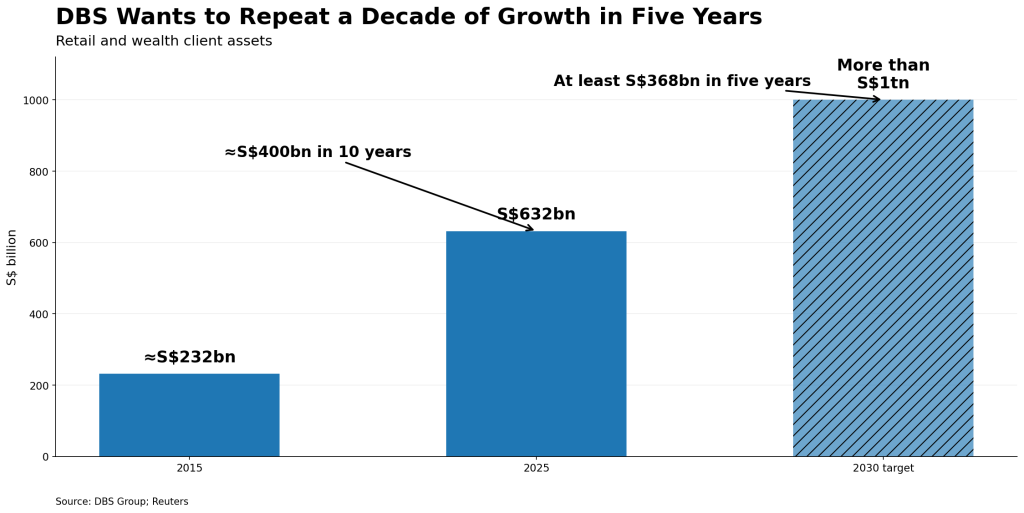
DBS Group wants to manage more than S$1 trillion (US$774 Bn) across its retail and wealth businesses by 2030. This target requires Singapore’s biggest bank to add at least S$368 Bn in client assets over five years.
The announcement comes as DBS’s own valuation reflects how seriously investors are taking the wealth push. On July 13, 2026, DBS became the first Singapore-listed company to close above S$200 Bn in market capitalisation, as investors placed greater weight on its growing wealth and fee-income businesses.
DBS expects much of the growth to come from customers it already serves. Its retail franchise gives the bank an early view of rising deposits and investment activity, allowing it to capture more of clients’ wealth as they move into affluent and private banking. For business owners and the ultra-rich, that relationship can extend to family-office services.
The push also gives DBS a buffer against falling interest rates. As lower rates compress lending spreads, fees from investments, insurance and advisory services are becoming a more important part of the bank’s earnings mix.
The S$1 trillion goal implies annual asset growth of nearly 10% on the S$632 Bn DBS held across its broader retail and wealth franchise at the end of 2025. The bank added about S$400 Bn over the previous decade and now wants to achieve nearly the same increase in five years.
“Looking at the traction, our ambition now is to grow the same S$400 Bn by half the time,” Shee Tse Koon, the executive who runs DBS’s consumer and wealth businesses, said at a press briefing.
The Internal Pipeline
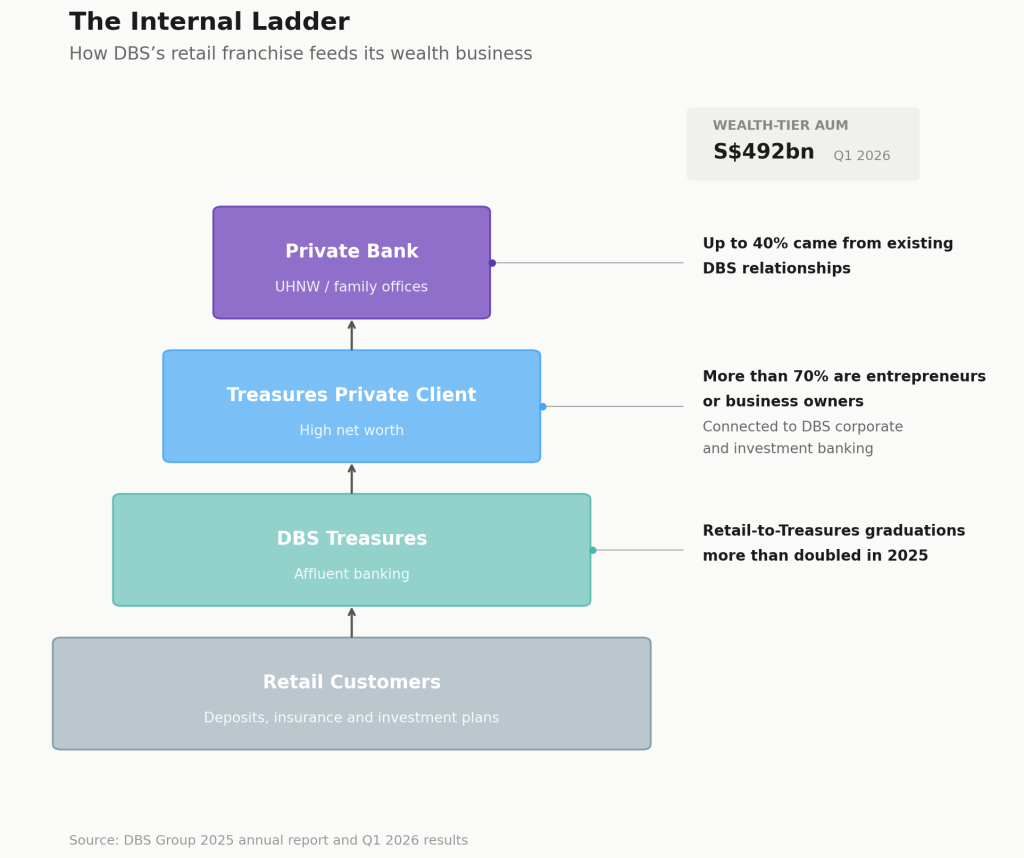
The scope of the target shows how DBS intends to get there. The S$632 Bn starting point covers both retail and wealth client assets, including deposits and simpler investment products. Its separately reported wealth franchise — Treasures, Treasures Private Client and Private Bank — had S$492 Bn under management at the end of March 2026.
The difference represents a substantial pool of customers who already use DBS but have yet to enter its higher wealth tiers.
That pipeline is already contributing to growth. The number of Singapore retail customers moving into DBS Treasures, its affluent-banking business, more than doubled in 2025. As many as 40% of its private-bank clients came from elsewhere within the bank rather than as wealthy customers from outside.
DBS can identify those clients before they appear on a rival private banker’s prospect list. Once they are inside the DBS ecosystem, they are harder to poach than customers who have already built their fortunes elsewhere. DBS already handles their salaries, deposits, mortgages, cards and investments, and in many cases, also banks the companies they own.
That allows the lender to add services as wealth is created. A customer may begin with a salary account, take out insurance or start investing regularly, and later qualify for affluent or private banking. A business sale, inheritance or expansion overseas can create demand for portfolio management, lending, trusts and succession planning.
The advantage is not simply access to more customers. It is the ability to retain them as their assets and financial needs grow.
The Fee Engine
Chief Executive Officer Tan Su Shan‘s background makes the emphasis on wealth unsurprising. She took the top job in March 2025 after more than a decade at DBS, much of it spent building the consumer and wealth franchise now at the centre of its growth plans.
That focus paid off. Core wealth assets rose 19% in constant-currency terms to S$488 Bn in 2025, twice their 2019 level. Clients added a record S$39 Bn of net new money, while the proportion of assets held in investments rather than cash reached 58%.
That mix matters. Client money generates more fee income when it is placed in funds, bonds, structured products, insurance and managed portfolios than when it remains in deposits. DBS therefore needs both fresh inflows and a larger share of existing assets to be invested.
Wealth-management fees rose 29% to a record S$2.81 Bn in 2025. Total income from the franchise increased 9% to S$5.7 Bn, with non-interest income climbing 27%. Net interest income in the combined consumer and wealth division, by contrast, fell 6% as lower rates compressed margins.
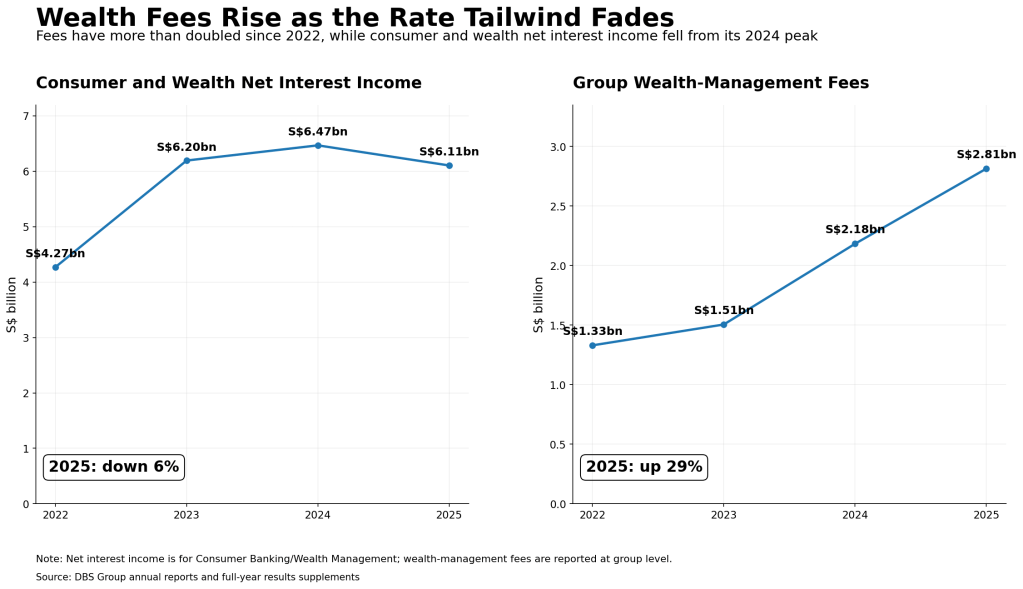
The divergence continued in the first quarter of 2026. Group net interest income declined 5% from a year earlier, while total fee income rose 16% to a record S$1.48 Bn, led by a 25% increase in wealth-management fees.
Wealth clients added another S$10 Bn of net new money, more than offsetting the impact of market and currency movements and lifting assets to S$492 Bn.
The figures show why wealth has become central to DBS’s strategy. It offers access to Asia’s growing pool of private capital while making earnings less dependent on the interest-rate cycle.
One Bank, Many Revenue Lines
DBS’s opportunity extends beyond personal investments. More than 70% of its high-net-worth clients are entrepreneurs or business owners, creating links between the wealth franchise and the group’s corporate and investment-banking operations.
A founder may use DBS to manage personal assets while the bank finances the company, hedges its currency exposure or advises on an acquisition, listing or succession plan. The same relationship can generate revenue across private banking, corporate lending, transaction banking and markets.
That is the economic appeal of what DBS calls its “One Bank” model. Handling more of a client’s personal and business finances expands the revenue pool and makes the overall relationship harder for a competitor to displace.
Euromoney named DBS the World’s Best Private Bank in March 2026, the first time in the award’s 22-year history that an Asia-headquartered lender had taken the top honour. The recognition matters less as a trophy than as a signal that the centre of gravity in global wealth management is shifting towards Asia — and that DBS is positioning itself at the point where that shift meets the region’s own wealth creation.
Automating Everything Except the Relationship
The harder task is scaling advice without allowing costs to rise in step with client assets. DBS plans to add more than 600 relationship managers, frontline advisers, engineers and platform specialists by the end of 2028, mainly in Singapore, Hong Kong, mainland China, India, Indonesia and Taiwan.
Hiring engineers alongside relationship managers points to how the bank intends to expand. Technology can handle more of the screening, analysis and routine administration surrounding each account, allowing advisers to serve more clients and spend more time on complex decisions.
DBS says artificial intelligence has reduced the time required for client-name screening by 75% and source-of-wealth profiling by 20%. Automation has freed about 10% more time for frontline advisers to spend with clients, a gain the bank expects to double by 2027. Its digital wealth platform has also produced a fivefold increase in financial-planning enquiries and a 42% rise in the use of regular savings plans.
The bank is expanding its physical network at the same time. It plans to open 18 wealth centres across its six main Asian markets by the end of 2027 and upgrade another 36. The programme will increase its Treasures-centre footprint in Singapore by 50%.
The investment in branches shows the limits of a fully digital model. Clients may buy funds or bonds through an app, but decisions involving the sale of a company, an inheritance, a trust or the transfer of family wealth still tend to depend on confidence in an advisor.
DBS is seeking to automate the work surrounding the relationship, rather than the relationship itself. It is also broadening its product reach through partnerships. In July 2026, it signed a memorandum of understanding with Samsung Securities to explore a wealth-management alliance that would give DBS clients access to South Korean investments and connect Samsung customers with DBS’s global multi-asset platform.
Singapore provides a strong base for that expansion. Assets managed in the city-state rose 12% to S$6.07 trillion in 2024. More than three-quarters of the money originated overseas, and 88% was invested abroad, highlighting Singapore’s role as a centre for cross-border wealth rather than simply a manager of domestic savings.
DBS says its wealth clients come from more than 120 jurisdictions and that it banks about a third of the more than 2,000 single-family offices established in Singapore. Its booking centres in Singapore and Hong Kong allow it to serve families whose businesses, homes and investments span several markets.
The S$1 trillion target remains exposed to forces outside the bank’s control. Client assets move with markets and currencies, meaning some of the increase may come from valuation gains rather than fresh money. Relationship managers and specialist engineers are also in high demand, while faster onboarding cannot come at the expense of the scrutiny required in cross-border wealth management.
Competition is intensifying, though, as both OCBC and UOB are pursuing the same structural opportunity, while global private banks continue to expand their Asian advisory and digital capabilities. OCBC’s wealth-management fees rose 34% in the first quarter of 2026.
DBS must also persuade clients to invest more of their money without allowing the drive for fees to compromise suitability or trust.
Its advantage is that it does not have to build the pipeline from scratch. The bank already has millions of retail customers, an affluent franchise producing private-bank clients and corporate relationships with many of the entrepreneurs whose fortunes it wants to manage.
The next S$368 Bn will depend less on finding a new generation of billionaires than on identifying rising wealth early, capturing a larger share of it and remaining the primary bank as clients’ financial needs become more complex.
DBS Group wants to manage more than S$1 trillion (US$774 Bn) across its retail and wealth businesses by 2030. This target requires Singapore’s biggest bank to add at least S$368 Bn in client assets over five years.
The announcement comes as DBS’s own valuation reflects how seriously investors are taking the wealth push. On July 13, 2026, DBS became the first Singapore-listed company to close above S$200 Bn in market capitalisation, as investors placed greater weight on its growing wealth and fee-income businesses.
DBS expects much of the growth to come from customers it already serves. Its retail franchise gives the bank an early view of rising deposits and investment activity, allowing it to capture more of clients’ wealth as they move into affluent and private banking. For business owners and the ultra-rich, that relationship can extend to family-office services.