The Biggest Market In Local Search Has Been Hiding In Plain Sight
Most local businesses concentrate their SEO efforts on their websites- building blogs, backlinks, etc.- in the effort to put their sites directly in front of local search demand for their products.
Opinions expressed by Entrepreneur contributors are their own.
You're reading Entrepreneur Asia Pacific, an international franchise of Entrepreneur Media.

For decades- general knowledge, universities, and digital marketing agencies alike have been telling small businesses that path to digital visibility is straightforward: build a better website, publish more content, improve search rankings, and supplement that with ads if you can.
This traditional advice may have made sense 20 years ago when the internet functioned primarily as a balanced, decentralized system of websites that were featured by Google (and other search engines) democratically as a simple directory.
But Google (which controls most of the search market) has since moved away from its yellow-pages directory model, and has become much more of a centralized platform that sought to control how search flows, who receives it, and the criteria that determine all of this. The rationale for why is obvious. It forces businesses to buy Google ads, use Google Analytics, and consume other Google products across its service ecosystem. This further ensures Google’s evergreen market share and relevancy, especially at a time when a lot of search is moving from search engines to LLM’s.
While this shift has taken place- right before our eyes in fact- few businesses (especially small, local businesses) have recognized it’s implications and even fewer have adapted the manner in which they focus their efforts to take advantage of how local search actually happens.
The Wrong Digital Storefronts Are Being Focused On
Most local businesses concentrate their SEO efforts on their websites- building blogs, backlinks, etc.- in the effort to put their sites directly in front of local search demand for their products.
Yet this effort (even when excellently executed) is misguided, as most local search demand will never reach a company’s website.
Rather, today most local customer search will never begin nor even arrive on their search journey at a company’s website.
They begin and are largely kept inside Google’s ecosystem up until an actionable lead (call or direction request) or a purchase is made.
The Actual Pathway Of Local Search
When someone searches for a nearby service such as a dentist, gym, pharmacy, or restaurant, Google nearly always presents the decision interface directly within its own ecosystem on both mobile and desktop.
Contact buttons, directions, reviews, photos, and service descriptions appear before a single external website link is clicked in the form of Google Business Profiles (which again we will emphasize are Google run properties).
These listings- specifically the top 3 for most local searches- sit above most other search results and capture the vast majority of user attention.
This structural shift has quietly transformed how local demand is allocated online. Within the rapidly growing Google Business Profile marketing niche, this highly visible area is sometimes referred to as the “Critical Zone.”
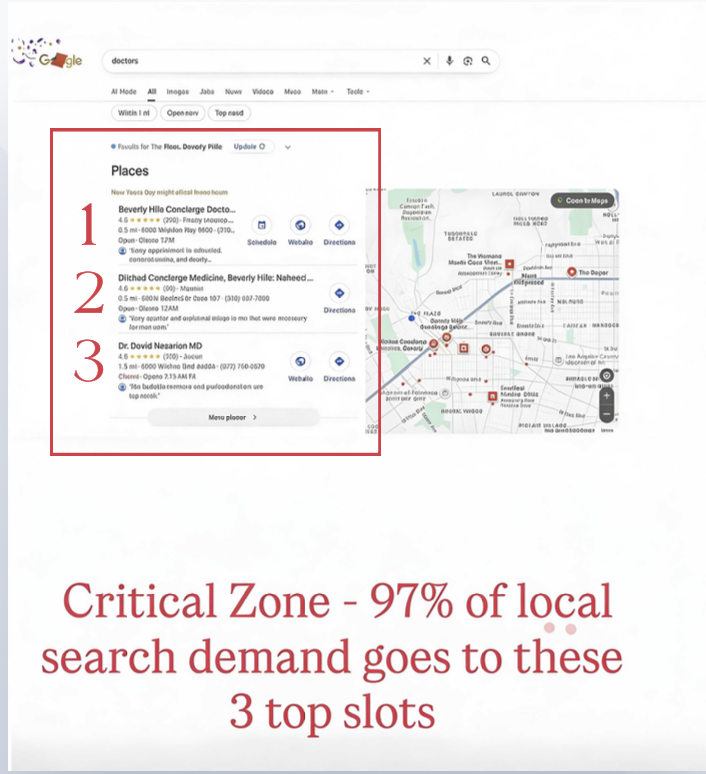
Businesses that appear here capture roughly 97% of local clicks for whatever product or service is being searched, while the rest of small businesses outside of the zone become largely invisible to local audiences and thus largely fail to be discovered, no matter how well designed or SEO-optimized their websites may be.
The implication is significant.
The Key Takeaway
Many small businesses are still investing heavily in the wrong digital infrastructure. They continue to optimize websites, build blogs, and purchase advertising designed to drive traffic that potential customers are unlikely to visit simply because no matter how optimized they get with traditional SEO, they’ll never rank highly enough to displace meaningful traffic from Google’s top listings (that Critical Zone of top 3 Google Business profile listings).
How Do We Adjust For This To Help Small Business
For small businesses, this creates both a challenge and an opportunity.
The challenge is clear. Competing directly with a giant, $3.4 trillion platform’s ecosystem like Google is difficult even for the biggest companies, and a total non starter for 99% of small business.
Thus the solution starts with awareness that up until now, by exclusively focusing on website seo they’ve been (likely inadvertently) competing with how Google wants to administer local search, and they can likely experience much greater results by learning how to and then playing (and winning) in Google’s system.
So How Do We Do That?
The first step is by focusing on the property that actually can be positioned to win- which is the local business’ Google Business Profile (rather than its website), wherein consistent profile updates, accurate service information, active customer reviews, geographic relevance, and ongoing engagement all help reinforce credibility and boost ranking, visibility, and through traffic within Google’s ranking logic.
This realization has also led to the development of new approaches designed specifically to compress all of these boosting factors into a turnkey tool that businesses can easily integrate in order to gain an unfair advantage over competitors when it comes to the visibility and relevancy of their Google Business Profile.
One such tool that takes a small business from being invisible across most of its product/service offering to dominating the local market for it is Rank & Radius, an AI, machine learning tool that tags, updates, and provides relevant content for the service keywords/products a local business offers in relation to each serviceable area within a ~100 mile radius on it’s Google Business Profile to the point where each service of what if offers for each serviceable area starts to achieve a higher signal weight than competitors. And because the Google Business Profile market has largely been overlooked, a little effort in the way of geo tagging services/products to local markets where they can be performed goes a long way (in the absence of any competition).
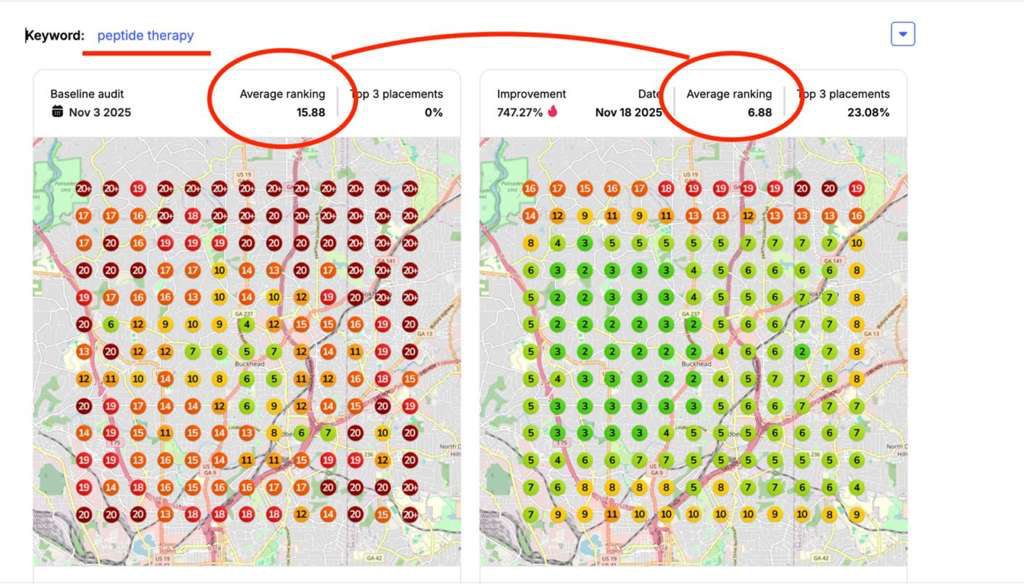
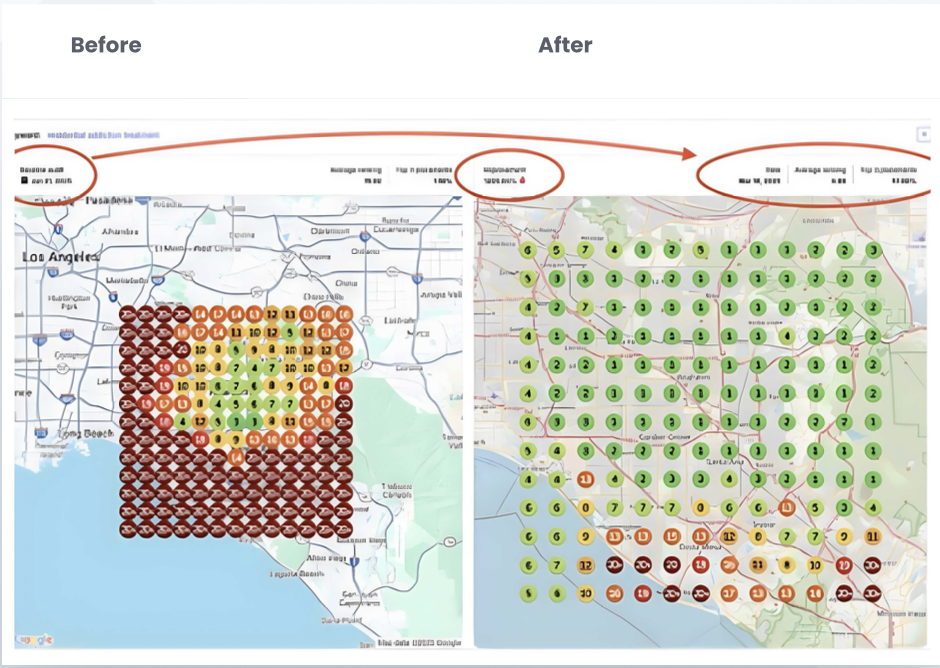
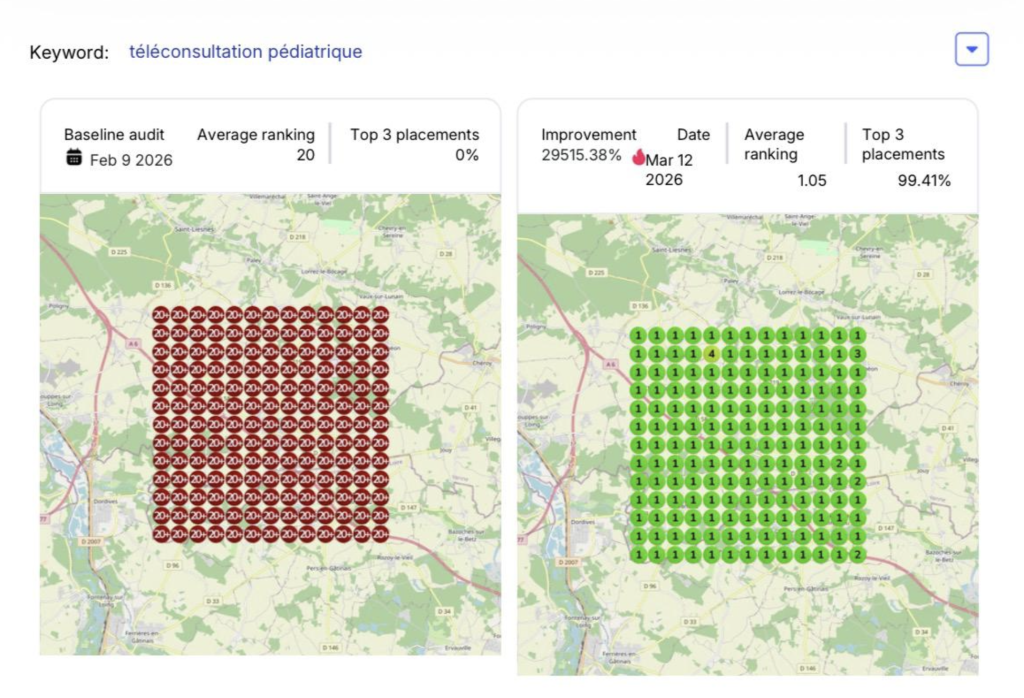
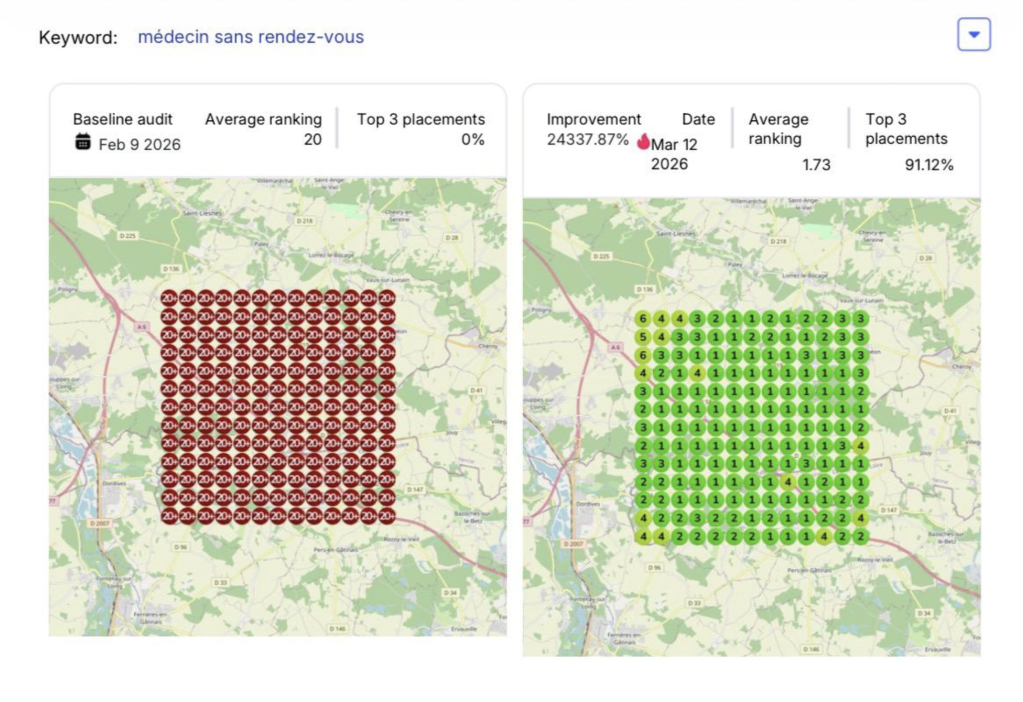
As a result, most Rank and Radius clients quickly (within 1-2 months) start to rank in that critical zone, higher than 99% of competitors for their every service/product across their every serviceable area. As you can see below, within just 45 days, Rank and Radius clients like Fit 9 Atlanta, Recovery Beach Orange County, and Tessan France have gone from being largely invisible for most local search demand to capturing most of the local demand (60%+) for what they sell through their Google Business profile.
Implications
By playing in and winning in Google’s system- where the Google Business Profile and not the website- is a local business’ primary digital storefront, Rank and Radius is positioned as a turnkey bridge for local businesses who want to smart approaching customer growth in a smarter, down stream way.
The agile brands who do this will gain an unfair advantage and be the first to make a land grab- gaining key first mover advantage- in a sluggish, antiquated market that has yet to become aware or adapt to how to attain local search (even though the 3 Google Business profiles- the critical zone- is outranking them on every search and taking most of their market away). As a result, they will capture a disproportionately high amount of local search for as long as Google’s infrastructure is set up to flow demand this way and for as long as Google remains today’s dominant search engine.
For decades- general knowledge, universities, and digital marketing agencies alike have been telling small businesses that path to digital visibility is straightforward: build a better website, publish more content, improve search rankings, and supplement that with ads if you can.
This traditional advice may have made sense 20 years ago when the internet functioned primarily as a balanced, decentralized system of websites that were featured by Google (and other search engines) democratically as a simple directory.
But Google (which controls most of the search market) has since moved away from its yellow-pages directory model, and has become much more of a centralized platform that sought to control how search flows, who receives it, and the criteria that determine all of this. The rationale for why is obvious. It forces businesses to buy Google ads, use Google Analytics, and consume other Google products across its service ecosystem. This further ensures Google’s evergreen market share and relevancy, especially at a time when a lot of search is moving from search engines to LLM’s.

Thomas Herd is an American Entrepreneur and a pioneer of quantifiable digital marketing. He is... Read more