Antares Raises Over $50 Mn as Family Offices Back Deeptech Fund
The Singapore VC has deployed about $27 Mn across nine companies as it raises its first institutional fund towards a $100 Mn target, giving family offices access to energy, infrastructure and industrial technologies through a specialist manager.
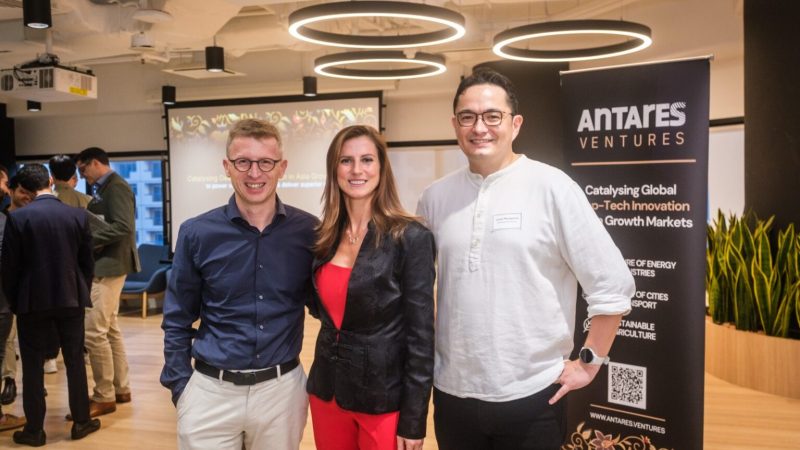
Antares Ventures
Opinions expressed by Entrepreneur contributors are their own.
You're reading Entrepreneur Asia Pacific, an international franchise of Entrepreneur Media.
Singapore-based Antares Ventures has secured more than $50 Mn at the second close of its first institutional fund, Antares Ventures I, which is targeting $100 Mn. The close brings family offices, along with corporate and strategic investors from Southeast Asia, Japan and South Korea, following a first close earlier this year.
The VC has already invested about $27 Mn across nine companies spanning energy storage, power grids, industrial systems, water treatment and transport, putting about half of the committed capital to work while fundraising continues.
For Antares, the fund scales a model that founder and managing partner Michael Gryseels, a former group chief digital officer at Thailand’s Charoen Pokphand Group, has run since 2019. Before launching the institutional vehicle last year, Antares operated as a syndicate, investing deal by deal through special purpose vehicles.
Gryseels said Antares completed 26 deals before launching the fund and recorded seven exits, all through corporate acquisitions.
The change is primarily one of structure and scale. Family offices that previously had to assess individual deeptech deals can now invest as limited partners in a diversified fund, while Antares handles technical diligence, portfolio construction and commercial development. Antares typically writes cheques of $1—5 Mn, mostly $2—3 Mn, and prefers to lead or co-lead rounds and take board seats.
This matters especially in sectors where investment decisions rely on both engineering and financial metrics. Energy storage systems, grid infrastructure and industrial processes often require years of testing and customer validation before they can be scaled up. This can raise the barrier for investors without specialised teams.
A Portfolio Built Around Asia’s Bottlenecks
Antares’ current portfolio reflects that focus. Singapore-based VFlowTech develops long-duration energy-storage systems. UK-based IONATE works on grid technology. Germany’s enaDyne develops plasma-based industrial processes. And India’s ePlane Company is building electric aircraft. Other investments include Singapore’s Ackcio and Hydroleap, which focus on infrastructure monitoring and water treatment, while Ayrton Energy, FeX Energy and Open Ocean Robotics focus on hydrogen transport, industrial heat and autonomous ocean monitoring.
The companies are geographically diversified, but Antares is looking for a common commercial opportunity: technologies that can address bottlenecks emerging as Asia spends more on power, data infrastructure, manufacturing and transport. According to Gryseels, the overseas companies it backs must commit to entering Asia within 12 months of the investment.
That opportunity has become more visible as AI infrastructure expands. New data centre capacity increases demand for electricity, grid connections, cooling and water, while manufacturers face pressure to improve energy efficiency and capacity. Antares targets businesses that sit behind those systems rather than building software applications on top of them.
The Commercialisation Test
The more difficult part is commercialisation. Industrial and infrastructure customers tend to adopt new technology more slowly than software buyers, mostly because equipment failures can disrupt production and essential services. Hardware companies may also need manufacturing capacity and supply chains in place before revenue reaches meaningful scale.
Antares says it works with portfolio companies on pilots, partnerships, localisation and customer development in Asian markets. That operating role is intended to shorten the path between technical validation and commercial deployment.
Its pre-fund exits also point to a potential route to liquidity. Selling to corporate buyers gives portfolio companies an alternative to relying on an IPO or a financial buyer. Strategic acquirers may value intellectual property, engineering capabilities or products before a business reaches public-market scale.
For family offices, the fund, therefore, provides ample exposure to an asset class that can be difficult to access directly, while spreading risk across multiple technologies and markets.
Putting Singapore’s Family Offices to Work
The timing also fits a broader shift in Singapore’s private wealth market. More than 2,000 single-family offices (SFOs) were receiving tax incentives at the end of 2025, according to the Monetary Authority of Singapore. MAS chairman Gan Kim Yong told a family-office summit this month that families could contribute not just capital but business experience and networks to young companies, as Singapore looks to connect more private wealth with its innovation ecosystem.
Singapore has separately expanded public support for deeptech, with S$1 Bn set aside under Startup SG Equity for both early- and growth-stage deeptech investments following Budget 2026.
Antares is already part of that capital network. In February 2025, SEEDS Capital, then Enterprise Singapore’s investment arm and now part of SG Growth Capital, appointed it as one of 20 new co-investment partners under Startup SG Equity. SEEDS set aside S$150 Mn over three years to invest alongside private partners in Singapore-based deeptech startups.
Antares Ventures I, meanwhile, is targeting investors willing to accept longer development cycles in exchange for exposure to technologies tied to Asia’s infrastructure build-out.
Family offices can be a useful source of this capital because many aren’t constrained by the same liquidity requirements as institutional funds, and some bring operating-business experience and industry relationships alongside money.
From Commitments to Contracts
But the economics still have to work. Antares has secured enough capital to build its portfolio while it keeps raising. With about $27 Mn already deployed, the next test is whether its portfolio companies can convert technical advantage into commercial contracts, scale across Asian markets and generate exits that compensate investors for longer holding periods and higher technology risk.
For Singapore, that outcome will matter beyond one fund. Antares is testing whether the city-state’s expanding pool of family-office capital can become a meaningful source of financing for specialist technology strategies, rather than remaining concentrated in wealth-management and more conventional financial assets.
Singapore-based Antares Ventures has secured more than $50 Mn at the second close of its first institutional fund, Antares Ventures I, which is targeting $100 Mn. The close brings family offices, along with corporate and strategic investors from Southeast Asia, Japan and South Korea, following a first close earlier this year.
The VC has already invested about $27 Mn across nine companies spanning energy storage, power grids, industrial systems, water treatment and transport, putting about half of the committed capital to work while fundraising continues.
For Antares, the fund scales a model that founder and managing partner Michael Gryseels, a former group chief digital officer at Thailand’s Charoen Pokphand Group, has run since 2019. Before launching the institutional vehicle last year, Antares operated as a syndicate, investing deal by deal through special purpose vehicles.