US–China Tariff Deal Shifts Asia’s Trade Dynamics — Can India Hold Its Edge?
Last week, the world’s two largest economies pulled back from the brink and agreed to a limited trade détente.
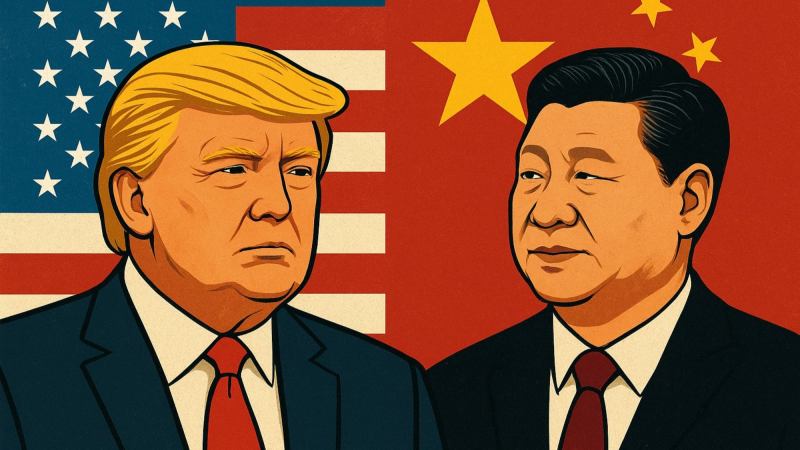
Representative Image
You're reading Entrepreneur Asia Pacific, an international franchise of Entrepreneur Media.
A recent handshake between U.S. President Donald Trump and China’s Xi Jinping at the Busan Summit last week in South Korea sent a message to the world that this was more than a mere diplomatic thaw — its ramifications could pave the way for an economic reset across Asia. Last week, the world’s two largest economies pulled back from the brink and agreed to a limited trade détente. The world’s oldest democracy rolled back some tariffs on Chinese goods, while China was persuaded to resume large-scale purchases of U.S. soybeans and ease curbs on rare earth metals — once a flashpoint in both countries’ diplomatic playbooks.
“As far as this truce is concerned, across Asia, the challenge is to balance both China and the U.S.,” Tilak Jha, China Expert and Associate Professor at Bennett University. “Nations right now are experimenting with multi-hedging strategies — building parallel ecosystems and alignments based on their own stakes and possibilities. Trade will be the defining element of this new order.
According to Jha, China has been leveraging its technological advantage also called ‘choke tech’ — to consolidate power and influence.
This trade détente can have a huge impact on Asia-Pacific economies, which account for nearly 60 per cent of the world’s intermediate-goods exports. The truce not only offers relief from inflationary pressures but also eases the supply-chain constraints that have battered regional production since 2020. According to the International Monetary Fund (IMF), Asia’s GDP growth is likely to reach 4.5% in 2025, driven by a manufacturing rebound. However, the IMF also warned that “fragmentation risks could still shave off up to 2 per cent of output if geopolitical tensions escalate from here.”
“The region is witnessing new alignments shaped by domestic political developments and a growing sense of strategic hedging. Countries are coming together in loose frameworks so that, if something arises, they have room to maneuver,” Jha said.
Winners and Watchers
The prolonged U.S.–China tensions have tended to benefit ASEAN nations more than anyone else. According to UNCTAD, Vietnam saw an uptick in its exports to the tune of 19 per cent in 2024, as companies such as Samsung and Nike shifted their bases from China to escape the tariff onslaught by the U.S. Similarly, as per the ASEAN Investment Report, FDI inflows jumped by 12 per cent and 9 per cent in 2025, riding on the back of electronics and automotive investments flowing into these countries.
“This looks like an early attempt to reset the U.S.–China narrative by reopening selective trade channels to restore confidence. Hard to call this a clean risk-on. It feels more like risk-managed trading while investors wait for the China readout for clarity,” Charu Chanana, Chief Investment Strategy, SAXO, Singapore said.
Trade experts believe the easing of U.S.–China tensions are likely to slow the pace of relocations, but the tariff pause reinforces Southeast Asia’s status as a safety valve for global manufacturing.
Semiconductor Stability
Another area where this trade truce brings relief is the semiconductor and chip industry. According to Bloomberg Economics, Korean semiconductor exports nosedived by 14 per cent in 2024 but rebounded in Q3 of 2025 after early signs of policy easing. Similarly, Taiwan’s integrated-circuit exports to both the U.S. and China are likely to increase.
Experts in the chip industry believe that this trade détente may bring some much-needed stability to a sector battered by volatility in recent years — though full normalisation will take time to materialise.
India: Between Opportunity and Headwinds
For India, this détente presents a situation caught between opportunity and headwinds. Over the past five years, India has slowly and steadily benefited from the standoff between the U.S. and China, attracting significant investment under the China+1 strategy from companies such as Foxconn and Apple, as global conglomerates sought to de-risk their supply chains.
Now, the trade truce between the U.S. and China alters that dynamic. A close look at India’s trade with the U.S. in FY25 shows how the country benefited from the China+1 trend, as exports grew 12.3 per cent in FY25, driven by this diversification momentum. India still holds the crown as an attractive investment destination, largely because of its vast domestic market and incentives offered under the Production-Linked Incentive (PLI) scheme.
A recent handshake between U.S. President Donald Trump and China’s Xi Jinping at the Busan Summit last week in South Korea sent a message to the world that this was more than a mere diplomatic thaw — its ramifications could pave the way for an economic reset across Asia. Last week, the world’s two largest economies pulled back from the brink and agreed to a limited trade détente. The world’s oldest democracy rolled back some tariffs on Chinese goods, while China was persuaded to resume large-scale purchases of U.S. soybeans and ease curbs on rare earth metals — once a flashpoint in both countries’ diplomatic playbooks.
“As far as this truce is concerned, across Asia, the challenge is to balance both China and the U.S.,” Tilak Jha, China Expert and Associate Professor at Bennett University. “Nations right now are experimenting with multi-hedging strategies — building parallel ecosystems and alignments based on their own stakes and possibilities. Trade will be the defining element of this new order.
According to Jha, China has been leveraging its technological advantage also called ‘choke tech’ — to consolidate power and influence.

Entrepreneur Staff • Editor
Entrepreneur Staff
For more than 30 years, Entrepreneur has set the course for success for millions of... Read more