Asia Pacific Service Firms Have an AI Opportunity in Their Operating History
Established service businesses may have records worth assessing for AI data licensing, and their advisors can open the conversation.

Partner content from SourceX
An Asia Pacific service company may have connected support and project history that merits a country-specific assessment.
Opinions expressed by Entrepreneur contributors are their own.
You're reading Entrepreneur Asia Pacific, an international franchise of Entrepreneur Media.
An experienced service company has already answered thousands of questions that a new AI system may struggle to handle.
Some were straightforward. Others required a clarification, a policy exception or a handoff between teams. Over time, that work may have left a detailed history across support platforms, project systems and internal documentation.
For founders and advisors in Asia Pacific, there is a commercial question worth exploring: could a qualifying company’s approved operational records support AI training or evaluation?
The question can begin with a relationship. A technology provider, accountant or former executive may know which business has the history and who can authorise a review.
A defined role for the person making the connection
The SourceX company referral program rewards eligible partners who introduce qualifying companies. Its standard rate is 25% of the actual supplier compensation SourceX pays, with a cumulative cap of US$100,000 per company, subject to terms and payment conditions.
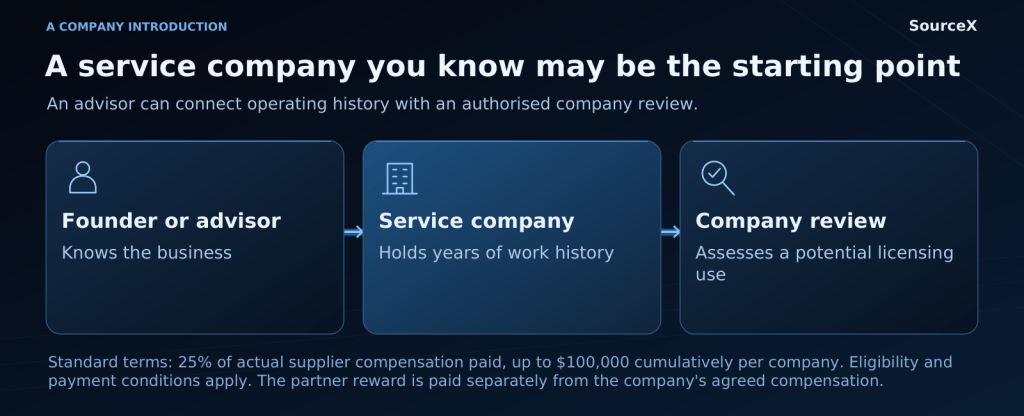
An advisor can connect operating history with an authorised company review.
The reward is conditional on a qualifying transaction. It is not paid merely for sharing a contact, arranging a meeting or securing a signature.
The introduction can nevertheless be valuable to both parties. The company gets an opportunity to assess whether its records fit a potential licensing use. The partner has a defined reward formula if the introduction leads to an eligible completed and paid transaction.
SourceX says it pays that reward separately, without reducing the company’s agreed supplier compensation. Explaining this alongside your potential interest makes the commercial relationship clearer.
Check the actual country and language rules
SourceX’s referral materials identify Australia, New Zealand, India and Singapore among its eligible source-company markets where at least 90% of the data is in English. They also look for at least 50 full-time employees at peak, excluding contractors, plus operating history and licensing rights.
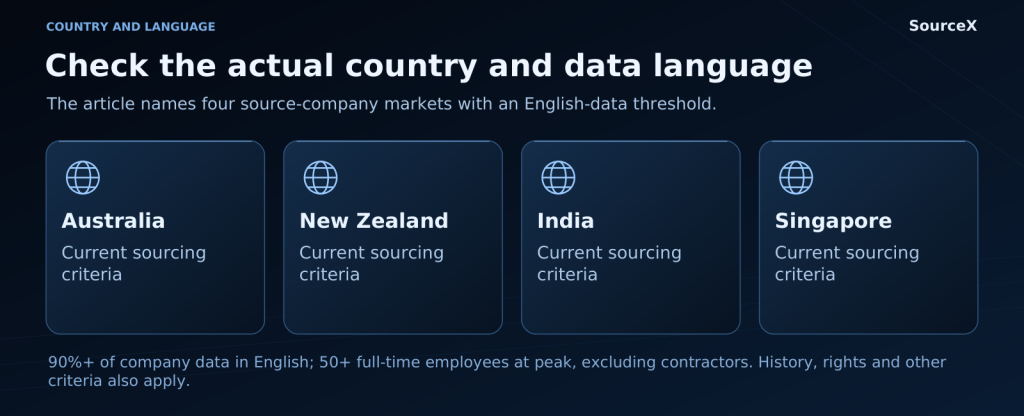
The article names four source-company markets with an English-data threshold.
These are specific criteria. They should not be expanded into a claim that every business across Asia Pacific qualifies. A company in another market needs to be checked against the current programme rules.
Language needs the same attention. An English-language sales presentation does not establish that 90% of a company’s operational data is in English. A preliminary description should distinguish what is known from what still needs review.
Partner eligibility is separate from supplier eligibility. Being able to participate as a referrer from a supported location does not automatically qualify the businesses that person introduces.
Service history needs a rights review
An illustrative outsourcing company might have years of customer support work. A technology services firm might hold project documentation and issue histories. Each collection can involve different rights depending on how the work was commissioned and which agreements apply.
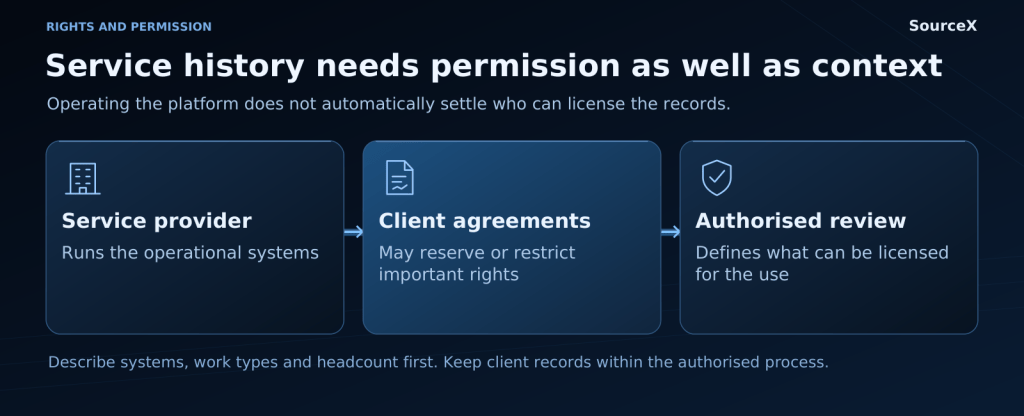
Operating the platform does not automatically settle who can license the records.
An organisation may operate a system while a client controls important rights in the material. That is a substantive question for the company’s authorised team. A referrer should never assume that providing the service gives the supplier an unrestricted right to license every record.
The useful first conversation identifies potential work types and systems. It can establish approximate headcount, operating history and the decision-maker without distributing client records.
Records also need to be useful for an actual project. Missing context, incomplete outcomes or inconsistent identifiers can limit what a buyer can do with a collection. A large archive is a starting point for assessment, rather than proof of value.

Illustration: Operating the platform does not automatically settle who can license the records.
Let the business evaluate the agreement
SourceX’s enterprise data licensing service describes a managed process involving scope, rights review, preparation, agreements and delivery. The company considers the proposed terms before authorising release of selected records.
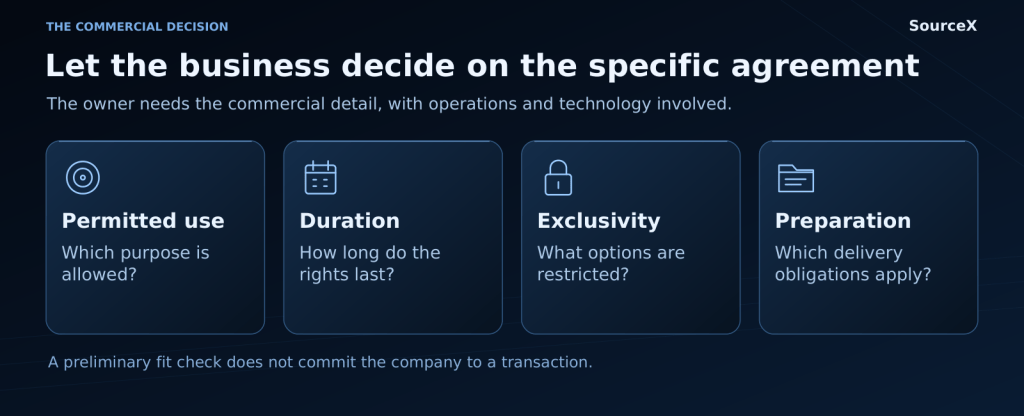
The owner needs the commercial detail, with operations and technology involved.
Those terms can include lasting rights and exclusivity. The owner should understand the permitted uses, duration, preparation obligations and commercial consequences of the specific licence. A preliminary fit check does not commit the company to accept a transaction.
For an advisor, the strongest contribution is often helping the company reach that decision with the right people involved. That may include operations, technology and leadership, along with whoever reviews the relevant contracts.
Start with one company you understand
Review the partner terms and any restrictions arising from your employment or professional role. New SourceX partners need account approval and the required signed channel partner agreement before submitting introductions.
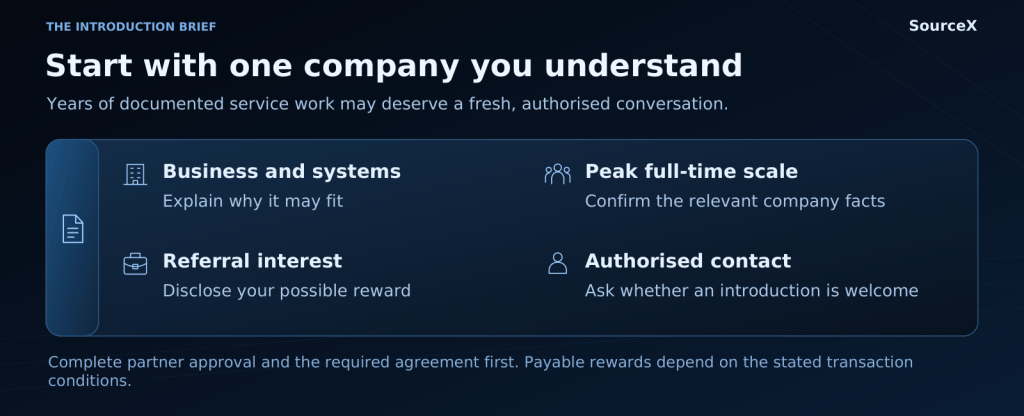
Years of documented service work may deserve a fresh, authorised conversation.
Then select a company whose operations you can describe accurately. Explain why it may fit, disclose your potential referral reward and ask the authorised person whether an introduction would be welcome.
The economics should remain precise. The standard percentage applies to actual supplier compensation paid, excluding separately itemised taxes and expense reimbursements. Buyer acceptance, cleared buyer payment, supplier payment, finance approval and complete partner payment and tax details are among the conditions for a payable reward.
For a well-connected founder or advisor, the opportunity may already be close. A company you know has spent years recording how work gets done. It may be time to ask whether that history has another approved use.
An experienced service company has already answered thousands of questions that a new AI system may struggle to handle.
Some were straightforward. Others required a clarification, a policy exception or a handoff between teams. Over time, that work may have left a detailed history across support platforms, project systems and internal documentation.
For founders and advisors in Asia Pacific, there is a commercial question worth exploring: could a qualifying company’s approved operational records support AI training or evaluation?
Covers capital flows, market structures, and the strategic thinking behind cross-border enterprises.